Google Website Translator Gadget

Showing posts with label Caofeidian port. Show all posts

Tuesday, March 1, 2011

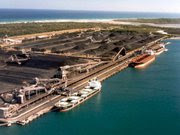
Caofeidian port rail coal supply rose last week


Mar 1, 2011 |en.sxcoal

Coal transported via railway to Caofeidian port, one of the coal-loading ports in northern China, increased 138,000 tonnes to 1.14 million tonnes in the week from Feb 21 to 27, according to the coal portal, operated by Qinhuangdao Seaborne Coal Market.

Coal haulage via railway averaged 163,000 tonnes per day last week, jumping 13.99 percent from a week ago, according to the report, adding the rail coal shipment had surged for two straight weeks.

According to statistics, Caofeidian port handled 894,000 tonnes coal in the week, up 71,000 tonnes or 8.63 percent from the previous week, especially over 160,000 tonnes from Feb 24 to 26.

As navigation at the port was closed for more than 50 hours, an average of 27 vessels waited off the port for loading, 18 vessels more than that in the previous week.

As of Feb 27, coal stockpiled at Caofeidian port stood at a higher level of 2.37 million tonnes.

Friday, February 25, 2011

Chinese industry steels itself for changes in next 5 years - CISA


Friday, 25 Feb 2011

China Daily quoted the China Iron and Steel Association as saying that steel mills in north and northeastern China should stop enlarging their production capacities during the 12th Five Year Period (2011-2015) as the industry prepares for large scale changes.

Analysts said a developmental trend in China will see steel mills being relocated to coastal areas for financial and environmental reasons.

Ms Zhang Lin a senior analyst from Beijing Lange Steel Information Research Center said China is learning a lesson from the major economies and is now planning to move the industry to the coastal areas from inland regions.

She said that "The move will be beneficial to the environment because steel production is a process which consumes huge amounts of water. Under the pressure of fewer resources and worsening environmental pollution, it is wise to make this change.”

She added that the move will provide savings for the steel companies in the importation of equipment. She also said "The companies used to spend a lot on transporting the imported equipment inland. However, if the mills are located on the coast and close to ports it will be more convenient and economical."

According to the Lange Steel Information Research Center, North China steel mills produced a total of 170.89 million tonnes in 2010 accounting for 27.26% of the national industry production.

Ms Zhang said north and northeastern China have long been the key production bases, and their production capacity is already big enough to meet targets. It is part of a strategic plan to move production to the coastal areas to ensure the sustainable development of the industry.

Shougang Group, formerly the largest steelmaker in Beijing, moved its production facilities to Caofeidian Port in Hebei province in January. Ms Zhang said the mills in Caofeidian are conducting research on the desalination of seawater for industrial use, a development which if realized, will prove profitable for the industry.

CISA has also asked steelmakers to diversify their range of products, and contribute more towards the development of high speed railways, urban metro lines, oceanographic engineering off shore oil exploration and the renewable-energy industries.

(Sourced:China Daily)
Tags:steel production, northeastern china, Beiging, China Iron and steel association

Saturday, February 19, 2011

North China ports see coal stocks down 0.88 pct

Feb 18,2011

Coal stockpiles at four major loading ports in northern China slightly decreased 0.88 percent in the week from Feb 11 to 17, according to a report published by industry portal cqcoal.com.

As of Feb 17, a total of 14.74 million tonnes coal was stockpiled in ports of Qinhuangdao, SDIC Caofeidian, Jingtang and Tianjin, dropping 132,000 tonnes from a week ago.

Qinhuangdao, China’s top loading port of the fuel, had 7.38 million tonnes coal in stock on Feb 17, up 2.92 percent or 227,000 tonnes from the previous week, data showed.

Meanwhile, coal stocks at ports of SDIC Caofeidian and Jingtang grew 4.67 percent and 4.93 percent to 2.24 million and 3.19 million tonnes respectively, an increase of 100,000 and 150,000 tonnes, while that at Tianjin port declined 8.02 percent or 155,000 tonnes from a week ago to 1.78 million tonnes, according to statistics.

Coal shippers were active to transport power generating coal to secure power supply in southern China during the Spring Festival

Meanwhile, downstream main power plants sent more vessels to ports to load coal, primarily in-plan power coal, to replenish their stocks.

(sourced:en.sxcoal.com)