Google Website Translator Gadget

Showing posts with label Tuesday March01 2011. Show all posts

Tuesday, March 1, 2011

Budget update - Indian miners cry foul over iron ore export tax hike


Tuesday, 01 Mar 2011, PTI

Indian finance minister Mr Pranab Mukherjee’s move did not gel well with the Federation of Indian Mineral Industries, which saw steel cartel of few majors behind the hatching of the move and termed it as a huge blow for domestic iron ore producers.

Mr RK Sharma general secretary of FIMI, while observing that the entire proposal was self defeating, warned that production will come down as a result of which steel prices will go up making end users suffer.

He said “The entire proposal is self defeating. It too means a huge loss to the exchequer, he said adding the future of 1 million people directly employed with the mining industry is also at stake.”

Tags : raw material, steel mills, Steelmakers,

Stakhaniv Railcar to supply 400 freight cars to Poltava Iron Ore in 2011


Tuesday, 01 Mar 2011

It is reported that Stakhaniv Railcar a major producer of freight railcars in Ukraine will supply 400 freight railcars to affiliated Poltava Iron Ore with an option for another 600 units.

According to Millennium Capital analyst “We consider the news as POSITIVE for the Stakhaniv Railcar. We estimate the order will add at least USD 26 million to the company’s top line in FY11.”
(sourced:Millennium Capital)

Russia abandons iron ore and steel export duty plans


Tuesday, 01 Mar 2011

Interfax citing Mr Andrei Slepnyov deputy economic development minister as saying that Russia has abandoned plans to impose an export duty on iron ore and rolled steel products.

According to the deputy minister, automakers and steel producers have reached agreement on delivery and prices and therefore it is no longer necessary to impose an export duty.
(sourced from Interfax)

Tags : agreement, raw material prices, steel mills,

Guizhou, Shanghai cos. to jointly develop coal resources


Mar 1, 2011

Double Dragons Inc., based in Guizhou province of northwestern China on Feb 28 signed a cooperation agreement with Shanghai Yunfeng Group to jointly establish a large coal group for developing coal resources in Guizhou, Xinhua News Agency reported.

With a joint investment of nearly 2 billion yuan, the new coal group would mainly engage in coal production and deep-processing in Guizhou. It plans to have production capacity over 10 million tonnes and production value in excess of 10 billion yuan during the 12th Five-Year Plan period, according to the report.

Double Dragon, a comprehensive private company, focuses on business of coal, phosphorus chemical, food and trade, while Shanghai Yunfeng, a large state-owned company, mainly conducts business in energy, automobile, real estate and logistics.Coal-rich Guihzou holds coal reserves up to 50 billion tonnes, ranking the fifth in China.(By Xinhua)

Tags : coal, raw material, steel mills, coal production, agreement

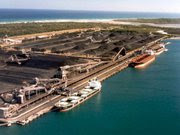
Caofeidian port rail coal supply rose last week


Mar 1, 2011 |en.sxcoal

Coal transported via railway to Caofeidian port, one of the coal-loading ports in northern China, increased 138,000 tonnes to 1.14 million tonnes in the week from Feb 21 to 27, according to the coal portal, operated by Qinhuangdao Seaborne Coal Market.

Coal haulage via railway averaged 163,000 tonnes per day last week, jumping 13.99 percent from a week ago, according to the report, adding the rail coal shipment had surged for two straight weeks.

According to statistics, Caofeidian port handled 894,000 tonnes coal in the week, up 71,000 tonnes or 8.63 percent from the previous week, especially over 160,000 tonnes from Feb 24 to 26.

As navigation at the port was closed for more than 50 hours, an average of 27 vessels waited off the port for loading, 18 vessels more than that in the previous week.

As of Feb 27, coal stockpiled at Caofeidian port stood at a higher level of 2.37 million tonnes.

China coal contract price likely to rise by RMB30/t on delivery

March 1, 2011 | Xinhua

China's coal price is expected to keep rising in 2011 and the actual delivery price of contracted coal for 2011 is likely to rise by 30 yuan/tonne due to less pressure from energy conservation and emission reduction measures and international coal price hike, said China Energy Research Society (CERS) in a report made public recently.

The temporary ease of energy conservation and emission reduction pressure is expected to more or less boost the country's coal demand.

Meanwhile, the government control in contracted coal price for 2011 seems not work out as expected especially when China's coal price is highly market-oriented. Even if coal price is under control, the quality of supplied coal could hardly be guaranteed.

Besides, the international coal price is maintaining a strong momentum of rising on recovering international economy and energy demand, especially robust demand in Asian emerging markets.

China's domestic coal price is expected to follow the international coal price hike in the second half of 2011, said CERS in the report.

CERS noted that the surge in delivery price for contracted coal may further expand losses of thermal power enterprises in 2011.

New Millennium, Tata to extend iron ore deal


Tue,March01,2011

March 1 - New Millennium Capital Corp said late Monday it has agreed to extend an iron ore project exclusivity agreement with India's Tata Steel , which could potentially feed the world's No.7 steelmaker's European unit.

Both companies have mutually agreed to extend the exclusivity period to March 7 from February 28, New Millennium (NML) said.

Tata Steel and NML shall continue to work toward negotiating a binding agreement for the development and operation of the LabMag and KeMag iron ore projects, the company said.

NML had extended Tata's exclusivity right twice -- once by 18 months till the end of last year and once till Feb. 28. (Edited by Reuters)

Tags :LabMag iron ore project, KeMag iron ore project, steel mills, steelmaking

Zimbabwean President Mugabe to step up grab of SA, foreign companies


President Robert Mugabe launches his "anti sanctions campaign" tomorrow as part of his new election drive

Tue, March01,2011 06:34:41 AM
By Dumisani Muleya

SOUTH African and other foreign-owned companies are expected to come under growing threats of seizure in Zimbabwe after President Robert Mugabe launches his "antisanctions campaign" tomorrow as part of his new election drive.

The threats could reverse Zimbabwe’s nascent economic recovery and push the country back onto a slippery slope.

Investors worried about Mr Mugabe’s indigenisation laws have been watching closely. Some have frozen their investment plans, while others have beaten a hasty retreat, as shown by capital flight.

Mr Mugabe said on Saturday at his 87th birthday celebrations that he wanted the campaign to take over foreign-owned companies to be intensified.

He specifically urged Indigenisation Minister Saviour Kasukuwere to move quickly to take control of foreign companies, starting with nutrition giant Nestle.

The Swiss multinational ran into problems with Mugabe’s Gushungo Dairy last year after refusing to buy his milk under international pressure connected to sanctions.

"Nestle refused to buy milk from Gushungo dairies. I told Kasukuwere to begin with them and say he was sent by Gushungo."

Mugabe’s calls could open floodgates for the seizure of foreign- owned businesses.

Mr Mugabe urged his minister also immediately to target platinum producer Zimplats, which is owned by SA’s Impala Platinum.

Implats has submitted plans for meeting indigenisation demands and is in talks with the government. A spokeswoman declined to comment on Mr Mugabe’s latest pronouncement, saying, "It’s a very sensitive issue for us."

Implats CEO David Brown said at a results presentation last month it wanted clarity on how indigenisation would be carried out. It has outlined suggestions for an equity portion, release of mineral rights back to the state and investment in social and infrastructure projects.

Pretoria Portland Cement CEO Paul Stuiver said yesterday: "There is a procedure for industries to get together and negotiate with the ministers concerned regarding indigenisation. By no means is it a grab or fait accompli — it’s a process in motion." With Allan Seccombe and Mark Allix. (sourced:Business Day)

Iranian steel market trend in week 8 - Billet

Tuesday, 01 Mar 2011

Billet market experienced some declines for size 150 mm during last week in Iran. It was down by USD 10 per tonne to USD 590 per tonne and USD 623 per tonne in Northern and Southern ports including 3% VAT. Price of other sizes of 100 mm and 125 mm were stable.

Billet price has stopped dropping in Iran because of two reasons:
1. Prices have reached the bottom and should start rising sooner or later.
2. Suppliers confident about market improvements in the New Iranian Year are holding wait and see policy.

At the end of last week, 150 mm billet was transacted at USD 623 per tonne in Anzali port and size 125 mm up to USD 655 per tonne on truck including 3% VAT. Meanwhile minimum import offer price is USD 640 per tonne CFR Anzali port. Therefore, the gap between import offers and domestic prices has made market participants optimistic about future trend.(sourced:irsteel.com)

Mozambique to issue more coal licenses by 2012


Tue,March01,2011

MAPUTO – Mozambique will issue more coal exploration licenses in three provinces between this year and 2012, a senior government official said on Tuesday.

National Mining Director in the Mineral Resources Ministry Eduardo Alexandre told Reuters foreign firms from North America, Europe and Asia will be invited.

"We hope to issue at least five exploration licences this year and next in the provinces of Tete, Niassa and Cabo Delgado in the northern regions of Mozambique," Alexandre said in an interview.

"We have areas where there is a potential existence of coal in the provinces of Niassa, Tete and Cabo Delgado."

The resource-rich state with vast, untapped coal deposits has so far granted 105 licenses for research and exploration of mineral resources.

Australia's Riversdale, India's Tata Steel, Brazil's Vale are looking to exploit coal in the country with billions of tonnes of mineable coal. Edited by:Reuters

Tags: world's untapped coal deposit, India, raw material,

Turkish mills cut steel production on low demand

Tuesday, 01 Mar 2011

Reuters reported that Turkish mills cut steel production as political unrest in North Africa and the Middle East continued to depress demand for steel billet and rebar.

As per report, Turkish producers were offering steel billet at USD 640 per tonne to USD 650 per tonne and rebar at USD 680 FOB but no major sales were achieved at this level.(sourced:Reuters)

Budget update - Incentive for setting iron ore pallet plant


Tuesday, 01 Mar 2011

The withdrawal of export duty on pellets should encourage mining firms to set up more pellet plants in India

Chinese pallet plant technology and equipment providers should benefit from this move.

Iron Ore-Prices steady as market weighs India tax hike

Tue Mar 1, 2011 8:04am GMT

* Prices could rise $10-$15 near term on India move-trader

* India quadruples export tax on iron ore fines
(Updates Shanghai rebar price, adds China steel output)

By Manolo Serapio Jr

SINGAPORE, March 1 (Reuters) - Spot iron ore prices were mostly steady on Tuesday as slow demand from top buyer China tempered the impact of India's move to raise export duties, although traders said they expect prices to edge up later in the week.

India, the world's third-largest iron ore exporter, on Monday said it will quadruple export duties on iron ore fines to 20 percent as it seeks to curb exports, mostly destined for China.

The move which should further tighten global supply of the steelmaking ingredient and is likely to fuel another rally in iron ore prices, which have declined since hitting record highs in mid-February.

Indian ore with 63.5 percent iron content was quoted at around $188 a tonne, including freight, in China on Tuesday, said Chinese consultancy Mysteel.

"I think the increase in iron ore tax would have an impact on prices but it will take at least a couple of days for that to sink in," said a Shanghai-based iron ore trader who sells Indian cargoes to China.

"People would prefer to wait and watch. Prices had been coming down before the tax was announced, so they would stabilise first then there might be a slight increase," he said, adding he expects the Indian 63.5 percent grade to hit $190 within the week.

China's appetite for iron ore thinned last week as steel prices retreated after hitting a series of record highs last month, reflecting worries that Chinese steel demand might not pick up strongly because of the government's campaign to tighten monetary policy.

China's crude steel output rose 6 percent in the first 20 days of February from January, but stockpiles of steel products at major enterprises rose to 9.46 million tonnes from 7.57 million tonnes at the end of January, data from the China Iron and Steel Association showed.

STALEMATE

"I think there is a stalemate between the buyers and sellers right now and for us buyers we totally depend on the steel price in China," said a trader in China's eastern Shandong province.

"If the steel price would increase then we could accept any offers but I'm not sure the market is ready to accept ore at $200 because the end-user cannot accept the higher cost."

The most active steel rebar contract for October delivery on the Shanghai Futures Exchange fell to a two-month low of 4,816 yuan a tonne on Tuesday. It closed at 4,837 yuan, down 1.3 percent.

Huge stockpiles of imported ore at Chinese ports, which exceeded 80 million tonnes last week, are also deterring Chinese steel mills and traders from snapping up Indian material in the spot market.

"As long as you have a lot of stock available at ports which is typically cheaper than new imports, people would prefer to consume that first," said the Shanghai trader.

Still, Indian spot prices could rise by $10 to $15 a tonne in the near term because of the duty hike, said the Shandong-based trader.

Forward swaps rose on Monday as investors looked to more price rises. The Singapore Exchange-cleared March contract gained 0.7 percent to $176.67 a tonne, April rose nearly 2 percent to $167.17 and May jumped 2.3 percent to $163.92.

All three key iron ore indexes, which global miners use in determining quarterly contract prices, fell.

Platts iron ore benchmark IODBZ00-PLT slipped 50 cents to $183 a tonne, its weakest since Jan. 17 and marking its eighth consecutive session of losses.

Metal Bulletin's 62 percent index .IO62-CNO=MB dropped $1.36 to $180.5 a tonne, and The Steel Index's 62 percent gauge .IO62-CNI=SI slid $1.30 to 182.8, their lowest since mid-January.

Global miners like Vale and Rio Tinto are likely to raise second-quarter iron ore contract prices by 20 percent to an all-time high after spot prices hit a record peak this month, Reuters calculations showed on Monday.(Editing by David Fogarty,sourced Thomson Reuters)

Tags :Tags :raw material, Indian fine iron ore prices,CISA,iron ore traders, Platts, Metal Bulletin

Budget update - TATA Steel reaction on the Union Budget FY 12


Tuesday, 01 Mar 2011

TATA Steel said that “I rate Union Budget FY 12 as a balanced budget and a budget that is non-disruptive. FM is continuing with the policies of the Government since it came to power keeping the focus on growth and inclusiveness. The Government continues its endeavor to maintain robust economic growth and steady fiscal consolidation by focusing on economic inclusion, liberalizing FDI policy, boosting investment in infrastructure, agriculture and the social sector and simplification of procedures. The budget has to be seen in the context of the measures already announced and I am sure there will be several other measures that Government will announce progressively, to ensure that the economy exceeds the 9% GDP level at the earliest.”

“The Government's target GDP growth rate of 9% and commitment to bring down fiscal deficit to 4.6% of GDP for FY 2011-12 and 3.5% of GDP by FY 2014 are statements that hold a lot of promise. There has been a positive change in the quantum of fiscal deficit for FY 2010-11 which was at 5.1% of GDP against the previous budget estimate of 5.5%. The FM affirmed his resolve to introduce DTC from 1st April 2012. However as regards GST, the rollout including constitutional amendment is still in progress.”

“The increase in MAT rate, when it is felt that it is already high, would not have a beneficial effect on the industry, although this would be marginally offset by the reduction in surcharge. The imposition of MAT on SEZ developers will have an adverse effect on SEZs.”

“On personal taxes front, while the exemption limit has been increased to INR 180,000, there was need for greater increase keeping in mind the stubborn inflation over the past year and other factors. The liberalization of existing scheme of interest subvention of 1% on housing loan and enhancing housing loan limit to INR 2.5 million for dwelling units under priority sector lending are positives.”

“The focus on infrastructure sector is in keeping with India's insatiable need for enhanced infrastructure. India suffers from severe infrastructure deficit and any steps that are taken towards improving infrastructure are welcome. An increase of 23.3% over last year for infrastructure allocation, policy for development of PPP projects, increasing FII limits for investments in corporate bonds by USD 20 billion to USD 40 billion, and proposed issue of Tax free bonds of INR 30,000 crore will help in the process of capital formation and infrastructure development necessary to sustain the economic growth of the country. Industries like steel, that have high capital outlays and also have high contribution towards creating infrastructure, should have been categorized as infrastructure industry too.”

“While steps have been taken for the food sector in the form of steps announced for Food Security Bill, Mega Food Parks, Agriculture Produce Marketing Act, storage capacity and cold chains, allocations to various schemes, etc., the budget could have offered more on the short term measures to contain food inflation.”

“The continuation of the disinvestment policy with a target of INR 40,000 crores in FY 12 is a welcome measure.”

“I also believe that there was an opportunity to develop Mumbai as an international financial center in view of the decline of traditional financial centers in the West and elsewhere, but the measures expected to be announced in this regard fall short of what could have been done to capitalize on this opportunity. The various legislations proposed in 2011-12 and discussions to liberalize FDI policy are a positive. Foreign investment in mutual funds would enable greater inflows and greater participation in the Indian capital markets but at the same time, this would also require careful monitoring. Funds provided for capitalization of Public Sector Banks, Regional Rural Banks and NABARD are also strong positive measures to ensure financial robustness of these banks and encourage financial inclusion, though the banks are likely to require greater capitalization to cope with increasing growth.”

“The green orientation of the budget in the form of national mission for hybrid and electric vehicles, allocations for Green India Mission, Environmental Remediation Programs show the commitment of Government to addressing environmental challenges facing the country. The greater allocations for social sector (by 17%) and education (by 24%) are also welcome positives but delivery and execution in these areas are crucial, especially keeping in mind the recent governance failures.”

“The increase in export duty on iron ore exports (lumps and fines) to a uniform rate of 20% with the intention of encouraging value addition within the country is a step in the right direction but the exemption of duty on pellets also reduces the scope for greater value addition within the country. The value addition at the pelletization stage is much less compared to finished steel stage and the aim should be to encourage steel production within the country, which would lead to more jobs, output and value addition within the country. It has been a persistent demand of the steel industry to include steel plants as infrastructure industry and it is hoped that steel plants would be included in infrastructure as capital investment in fertilizer production has been included in this budget. FM may still consider this request of the steel industry.”

Budget update -Indian steel companies cheer iron ore export tax hike

Tuesday, 01 Mar 2011

India's steel industry cheered the 20% export duty hike on iron ore in the FY12 federal budget that will help contain escalating raw material costs and gave thumbs up to higher infrastructure spends, which will boost steel demand in the country.

Mr CS Verma chairman of Steel Authority of India said that "Higher export duty on iron ore has been a long pending demand of the steel industry and the budget has taken care of the issue.”

Mr H M Nerurkar MD of TATA Steel said “The increase in export duty is a step in the right direction but the exemption of duty on pellets also reduces the scope for greater value addition within the country. The value addition at pelletization stage is much less as compared to finished steel stage and aim should be to encourage steel production within the country, which would lead to more jobs, output and value addition within the country.”

Mr Sajjan Jindal vice CMD of JSW Steel hailing the move said this would lead to greater value addition at home and encourage domestic steel industry.

Mr K Ranganath CMD of KIOCL observed that iron ore is a natural resource which needs to be conserved. He said “Export of a value added product from iron ore will not only generate value in export but also provides higher scope for employment and generation of wealth in the value added industry.”

Mr Nittin Johari CFO of Bhushan Steel said that "The increase in export duty on iron ore will increase its availability in the domestic market, thereby stabilizing price and helping domestic steelmakers.”

Mr Ankit Miglani director at Uttam Galva Steels said that "There is nothing dramatic but there are more positives for the steel sector in this budget than negatives.”
(sourced:ET and PTI)

Australia iron ore miners to gain if India exports slow


Tue Mar 1, 2011 7:29am GMT

SYDNEY, March 1 (Reuters) - Rio Tinto , BHP Billiton and other Australian iron ore producers could be in for a windfall of higher prices in the third quarter after India moved to hike export duties on iron to 20 percent, sector executives and analysts said on Tuesday.

The gains would come at the expense of steel mills worldwide, which are facing higher costs for an indispensable raw material at a time when costs appeared to be trending down.

"This will inevitably lead to higher spot prices, which when indexed later in the year will be the basis for higher contract prices," said an executive with a Australian iron ore company who did not want to be named.

India, the world's third largest iron ore exporter after Australia and Brazil, wants to conserve supply for domestic steelmakers, who play a vital role in building growing infrastructure.

Almost all of India's annual 100 million tonnes of iron ore exports head to China and the duty increase announced on Monday will make exports uncompetitive.

India plans to raise the duty to 20 percent from 5 percent on fines and to 20 percent from 15 percent on lumps. Fines are dust form ore with a lower iron content than lumps.

The Australian government on Tuesday upped its forecast for Australian iron ore exports this year to 425 million tonnes, more than any other country, predicting China would continue to be the main driver in seaborne consumption.

Analysts said they may need to rethink revenue forecasts for iron ore producers if the hikes have an impact.

"The general view has been that market conditions were stimulating a supply side response and when the supply starts to lift, price would come down," said UBS commodities analyst Tom Price.

SIGNIFICANT IMPLICATIONS

For four decades, miners and mills had agreed on a single annual price. But last year, Rio Tinto and BHP Billiton, the world's No. 2 and No. 3 producers, led a shift to quarterly pricing, based on the lightly traded but transparent spot market. Each quarter's base price is now linked to the average price of the preceding quarter.

The shift was immediately adopted by other Australian producers, including Fortescue Metals Group , Atlas Iron and Mount Gibson Iron .

Fortescue Executive Director Russell Scrimshaw recently said his company was "selling every tonne of iron ore it could produce".

India's greater focus on domestic demand comes as it grapples with concerns similar to China's: trying to hold down inflation while battling to meet demand for cars, homes and other steel-related goods from populations of more than 1 billion. Indian steelmakers have projected capacity at 90 million to 100 million tonnes by 2012, an increase of at least 50 percent from 60 million tonnes now, which will boost their ore demand to about 150 million tonnes, or 67 percent, from 90 million tonnes.

"You can see how a pickup in the spot market, which in the past meant little or nothing to BHP and Rio, now has very significant implications," said Trent Allen of Resource Capital Research. "And this move by India will push up the spot price."

Spot iron ore prices have so far barely budged, with Chinese mills wary of buying more ore when steel prices are coming down and there is still a huge stockpile of iron ore at Chinese ports which are usually cheaper to buy.

Indian ore with 63.5 percent iron content was quoted at around $188 a tonne, including freight, in China on Tuesday, said Chinese consultancy Mysteel, but traders say prices could rise $10-$15 in the near term with India's move.

"I think the increase in iron ore tax would have an impact on prices but it will take at least a couple of days for that to sink in," said a Shanghai-based iron ore trader who sells Indian cargoes to China. (Reporting by James Regan,sourced:Reuters)

Tags:India's iron ore sector, trends,steel industry, analysis, impact of the duty hike, Australia sees commodities boom rolling on, Indian steelmakers, Spot iron ore prices,

Shougang to establish steel logistics processing base in Zhujiang Delta

Tuesday, 01 Mar 2011

It is reported that Shougang Steel Logistics Processing Base, with investment of CNY 0.15 billion in first phase and expected annual output value of CNY 2 billion and tax of CNY 30 million is expected to be put into production in Gangkou Town, Zhongshan City in the first half of 2011.

Shougang Jing-Tang Steel mill main project of the first phase has been put into production in 2010 with 10 million tonnes of steel for manufacturing plates which will explore market towards end customer. Economy in Zhongshan area developed fast involving equipment-manufacturing industry, home appliances and steering system parts and other industries which will promote high demand of steel.

Recently, Guangdong Municipal Government published Zhujiang Delta Industries Layout Program in 2010-2020 involving 150 projects including transportation, energy resources, water conservancy and informatization, with total investment of CNY 1976.7 billion in 10 years of which CNY 938.7 billion will be invested in 2009-2012.

Along with the fast speed of investing in Zhujiang Delta, steel demand will be further expanded which will lay a foundation for Shougang establishing steel logistics base in Zhongshan city. In addition, Mr Zhu Jimin President of Shougang Group hoped that the logistics base not only provide the current shearing and delivering services, but also provide stamping services.
(sourced:mysteel)

Tags : steel demand, China's domestic steel industry

China's yuan strengthens 46 bps against U.S. dollar Tuesday


Tuesday, March01, 2011 11:36

The value of Chinese currency Renminbi (RMB), the yuan, strengthened 46 basis points against U.S. dollars Tuesday.

The central parity rate was set at 6.5706 per U.S. dollar Tuesday, comparing 6.5752 per U.S. dollar the previous trading day, according to the China Foreign Exchange Trading system.

It is only one basis point away from the record high 6.5705 per U.S. dollar set on Feb. 21.

China's central bank announced on June 19 last year that it would reform the yuan exchange rate formation mechanism to improve its flexibility.

On China's foreign exchange spot market, the yuan can rise or fall 0.5 percent from the central parity rate each trading day.

The central parity rate of the RMB against the U.S. dollar is based on a weighted average of prices before the opening of the market for each business day.(Xinhua)

Mergers to continue in Chinese steel industry in 12th Five year Plan


Tuesday, 01 Mar 2011

China Securities Journal reported that Chinese steel market eyed rapid development since entering 21st century with the growth of crude steel output averaging by 21.1%YoY. The trend for the rather mystifying debacle after the Spring Festival has taken everybody by surprise.

In 2010, China has totally yielded out 630 million tonnes of crude steel. In recent years, Hebei Steel Group regrouped by Tangshan Steel and Handan Steel, realized rapid and steady developments forming a new management mode for further developments.

In the past two years, Hebei Steel Group accumulatively eliminated 5.2 million tonnes of backward steel making capacities and it also gradually regrouped 12 private owned steel mills.

Tags ; Chinese steel mills, Chinese steelmaking, mergers and acquisitions,

WISCO to halt blast furnace for maintenance in March


Tuesday, 01 Mar 2011

It is reported that WISCO has planned to start 40 days maintenance on blast furnace with 2200 cubic meters during February 26 to the beginning of April which might result in 200,000 tonnes capacity decrement of hot rolling medium plate, section, wire rod and bar production.

As per report, first HR and CSP production line will successively start 10 to 15 days maintenance. CSP hot rolling production line will first to be on maintenance which will lead to 6000 tonnes to 7000 tonnes decrement of rolled products. (sourced:mysteel)

Tags: HR and CSP production line, rolled products steel,