
Mon Feb 28, 2011 1:27pm GMT
* Soaring global prices could rise further
* Most exports go to China
* Industry body says exports will be uncompetitive
* India aims to keep more iron ore for domestic steel
* Shares in producer Sesa Goa slide
By Siddesh Mayenkar
MUMBAI, Feb 28 (Reuters) - India will quadruple export duty on iron ore fines as it seeks to curb exports, mostly to China, in a budget move announced on Monday that hit domestic producer shares and could push spot prices to new record levels.
The world's third largest iron ore exporter wants to conserve supply for domestic steel makers, who play a vital role in building growing infrastructure.
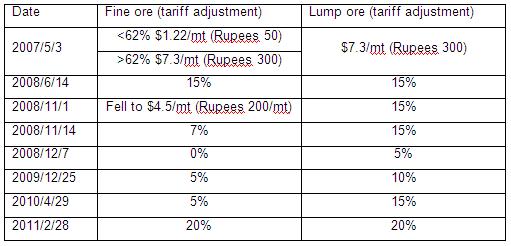
India plans to raise the duty to 20 percent from 5 percent on fines and to 20 percent from 15 percent on lumps. [ID:nSGE71R040]. Fines are dust form ore with a lower iron content than lumps.
"This will make the exports of (Indian) iron ore uncompetitive in the global market," said R.K. Sharma, secretary general of the Federation of Indian Mineral Industries (FIMI).
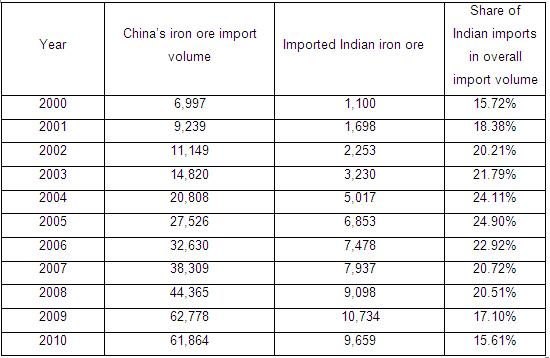
Almost all of India's annual 100 million tonnes of iron ore exports head to China. Its overseas sales compete with the world's top two exporters, Australia and Brazil.
"This could tighten up the market further," said Henry Liu, regional head of commodity research at Mirae Asset Securities in Hong Kong.
"This will increase the floor price for Indian prices and if Indian prices increase then that will push prices to China higher."
Shares in Indian iron ore miner Sesa Goa (SESA.BO: Quote) extended losses on the duty imposition, hitting a 52-week low.
Steelmakers welcomed the move.
"The increase in export duty on iron ore will increase its availability in the domestic market, thereby stabilising price and helping domestic steelmakers," said Nittin Johari, chief financial officer of Bhushan Steel (BSSL.BO: Quote).
MORE PRESSURE
The move was widely expected as India tries to underpin its rapidly-growing economy with investment in infrastructure.
China said it could pinch their margins as steel prices fall.
"Steel mills can't take costlier raw materials at the moment as steel prices were heading downward recently on weak demand," said an iron ore official a mid-sized Chinese steel mill, owning annual crude steel capacity of around 5 million tonnes.
But with iron ore miners in Australia and Brazil running flat out to cash in on prices near $200 a tonne, and little spare capacity elsewhere in the world, Chinese buyers have a difficult choice -- pay the additional tax, or cut production.
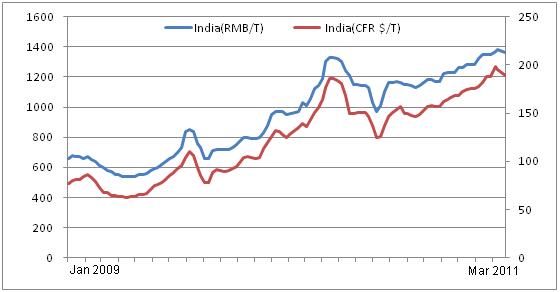
Iron ore was offered at around $189-191 per tonne with freight in China on Monday with little immediate impact seen by traders from the duty hike in a market where contracts are on a quarterly basis. The record high hit earlier this month was near $200 per tonne. [IRONORE/]
Shipping freight rates could be adversely affected by any further fall in exports from India.
"Freight rates will come under more pressure on this," said a Singapore-based shipbroker. "Rates are already at two-year lows on oversupply problems and this will only add to the problem."
India's iron ore exports have already slumped on the ban of shipments by the southern state of Karnataka -- contested by exporters in the Supreme Court -- with sales down 24.8 percent in December to 9.7 million tonnes from a year ago.
Exports during the April-December period fell 17.02 percent from a year earlier to 64.4 million tonnes. India usually exports around 100 million tonnes per year. China buys over 96 million tonnes, making India its third-biggest supplier.
Two other Indian states, leading producer Orissa and Chhattisgarh, which accounts for 5 percent of India's shipments, have asked the federal government to allow them to ban exports.
The government would prefer states to focus on improved regulation of the sector and incentives for increased domestic use of the resource. That would better target illegal production instead of export bans which hurt all producers.
India's steel minister, Beni Prasad Verma called for curbs on exports of iron ore on Friday. [ID:nSGE71O075]
India hiked freight rates for iron ore exports by 50 percent to 1,500 rupees per tonne on Jan. 27 but kept it unchanged in Friday's Railway Budget. [ID:nSGE70O07P]
The increase in export duty would bring in around $1.6 billion annually to New Delhi's coffers on the basis of the volume and price of exports to China in 2010. That is a fraction of the government's total expenditure of 12.58 trillion Indian rupees (nearly $278 billion). [ID:nINBUDGET]
( $1 = 45.275 Indian Rupees)
(Additional reporting by Manolo Serapio Jr. and Randy Fabi in Singapore, Ruby Lian in Shanghai, Swati Pandey in Mumbai; Writing by Jo Winterbottom; editing by Simon Webb and William Hardy, sourced:Thomson Reuters)




 Posts



