Google Website Translator Gadget

Showing posts with label hit record. Show all posts

Friday, November 4, 2011

China Bohai Thermal coal prices hit all time high

Friday, 04 Nov 2011

It is reported that the latest Bohai-Rim Steam-Coal Price Index or BSPI indicates that the average price of thermal coal with calorific value of 5500 kilocalories per kilogram reached an all-time high of CNY 853 per tonne in the week ending October 26.

The price was up CNY 6 per tonne or 0.71%t from a week earlier and an increase of CNY 28 per tonne compared with September 7 when a rebound was seen after nine consecutive weeks’ fall.

At Qinhuangdao port, the price of 5500 kilocalories per kilogram and 5800 kilocalories per kilogram thermal coal was up CNY 5 per tonne to CNY 850 per tonne to CNY 860 per tonne and CNY 900 per tonne to CNY 910 per tonne respectively compared with the previous week while that of 4500 kilocalories per kilogram and 5000 kilocalories per kilogram thermal coal kept stable at CNY 650 per tonne to CNY 660 per tonne and CNY 745 per tonne to CNY 755 per tonne.

In China's main coal-producing regions, such as Shanxi and Inner Mongolia, coal prices have remained stable after previous weeks upswing. Coal prices in these two regions have perched high for several weeks on speculation that China may face another round of power shortage in the coming winter. And the tough coal transport capacity may be one of the main reasons to bolster up the price.

(source: steelhome.cn/en)


Thursday, October 27, 2011

S.Africa's Transnet says moving RBCT coal at record

Thu,Oct 227, 2011

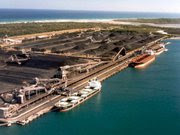
JOHANNESBURG (Reuters) - South Africa's logistics group Transnet has been moving coal to the Richards Bay Coal Terminal at record rates in recent months, showing the market that it may be turning the corner and reversing years of underperforming infrastructure.

Chief Executive Brian Molefe said on Wednesday that the company had recently managed to move 1.6 million tonnes of coal per week and expected to keep up the pace, while exports from the terminal had been around 1.4 million tonnes.

Coal producers in South Africa, including Anglo American, BHP Billiton, Exxaro, Optimum Coal and Xstrata, have long been eager to export more coal to meet rising demand from India and China.

"In the last three months we had record numbers of trains going to RBCT ... there are stockpiles at the terminal of around 5 million tonnes," Molefe told journalists, adding the company was exploring options to also transport coal to alternative ports around RBCT to ensure more shipments go out.

"Maybe we caught them (coal exporters) by surprise. I'm sure in the next few weeks they will catch their breath and ramp up their export capacity," he said, adding that the allocation of coal export capacity to emerging miners needed to be increased.

Transnet moved 63 million tonnes of coal to RBCT last year, far below the terminal's capacity of 91 million tonnes, but the logistics firm is investing heavily to raise capacity on the rail line to 81 million tonnes by 2015.

SWAZI LINK

The group also plans to free up an additional 14 million tonnes of capacity on the coal line by moving non-coal cargo to a new line via Swaziland.

The Swazi link, expected within six years, will cost around 12.3 billion rand.

Some 7.3 billion of that will be financed by Swazi Rail, and Molefe said its counterpart in the landlocked African state was confident it would find the money to build the link, despite the impoverished country's current economic woes.

Molefe also said a planned rail link to the Waterberg coal fields would be completed within the same six-year period and would carry over 20 million tonnes of coal per year.

Waterberg is expected to become the country's next coal hub and supply domestic power plants and exports as reserves in the Witbank area near depletion.

For years Transnet and the private sector have been discussing the option of using public-private partnerships (PPPs) to up volumes on the coal, iron ore or manganese lines, but Molefe said the company should be able to do it on its own.

"I don't see much scope for PPPs on those lines because our performance is good and we are improving volumes quite rapidly. One shouldn't temper with what is not broken," he said.

The company is working to expand the capacity on the iron ore line to 60 million tonnes from 47 million, and Molefe said the company is already studying the option of expanding the line beyond that, going up to 70-80 million tonnes a year.

Molefe said Transnet had just signed a 6 billion rand loan facility with the African Development Bank, and he saw no problems in raising funds needed for future expansion.

State owned Transnet said its earnings before interest, tax, depreciation and amortisation (EBITDA) for the six months to end-September rose 27 percent to 9.4 billion rand, while revenue was up 20 percent to 22.4 billion rand.

(sourced Reuters)

Friday, April 8, 2011

Oil holds above $124 as Libya conflict hits fields


By Nia Williams | Reuters

LONDON (Reuters) - Oil hit a 32-month high above $124 on Friday after attacks on Libyan oil fields raised the prospect of long-term supply cuts, with commodities in general rising on optimism global economic recovery will fuel demand.

Ongoing unrest in the Middle East and concerns postponed elections in Nigeria could spark a new wave of militant violence and disrupt supply also contributed to the bullish mood in the market.

By 1023 GMT Brent was up $1.49 to $124.16, after earlier touching $124.45, a level last seen in August 2008. U.S. crude climbed $1.34 to $111.64, just below an intra-day peak of $111.68 last reached in September 2008.

"It looks like some of the fields in Libya are starting to be the target for military strikes which is worrisome because it means we have a risk of losing more crude for longer," said Christophe Barret, commodities analyst at Credit Agricole.

Rebels and forces loyal to embattled leader Muammar Gaddafi exchanged bitter accusations over who had attacked oilfields and infrastructure vital to both sides.

The seven-week old civil war has cut Libya's 1.6 million barrels per day output by 80 percent to between 250,000 and 300,000, a senior government official said.

It took Kuwait two years to restore oil production to pre-war levels of about 1.6 million bpd, similar to Libya's pre-conflict production, after the 1991 Gulf War, according to International Energy Agency data.

Fellow OPEC member and 1.9 million bpd producer Nigeria, whose light, sweet crude is highly prized as an alternative to lost Libyan output, postponed parliamentary elections again in some areas although polls will go ahead in most of the country on Saturday as planned.

"Besides the ongoing fighting in Libya, the elections in Nigeria this weekend are also adding to the nervousness," said Commerzbank analyst Carsten Fritsch in a note.

"Possible supply losses in Nigeria, Africa's largest oil producing country, could further tighten the supply situation for high-quality oil especially."

Futher supply worries came from Norway where a trade source said the North Sea Oseberg crude oil stream will load 118,000 barrels per day in May, significantly down from the provisional programme of 160,000 bpd in April.

COMMODITIES BOOMING

Crude prices rallied in step with gains across the commodities market where gold hit a record high, driven by a weaker dollar and positive global outlook despite Portugal's request for a bailout earlier this week.

But surging oil prices have stoked inflationary concerns for governments worldwide due to the potential adverse impact on economic growth of the rising cost of foodstuffs and raw materials, and the risk of demand destruction.

"Awash with still extremely cheap money - the leading policy approach to cope with the passed recession - the investment community is pouring record volumes into long commodity positions," said analysts at JBC Energy in a note.

"This drives not only fuel and food prices to record highs, but also raises the costs for other raw materials massively, clearly putting the economic outlook under threat."

(Additional reporting by Randy Fabi and Alejandro Barbajosa; editing by Keiron Henderson,Thomson Reuters)

Wednesday, March 9, 2011

Petrol prices hit record in France


Mar07, 2011 06:47 pm

Petrol prices rose to a record high in France last week, with a litre of 95-octane petrol costing on average 1.5067 euros, according to information published Monday by a government agency.

he price, equivalent to $7.97 per US gallon, beat the previous record set in June 2008 of 1.4971 euros.

A litre of 98-octane petrol rose to an average of 1.5417, also beating the record of June 2008 of 1.5326 euros ($8.15 per US gallon).

The price of diesel, which accounts for 78 percent of sales in France, rose to an average of 1.3513 euros per litre ($7.15 per US gallon), some 10 cents below its record price.

Petrol prices at the pump have risen as the price of crude oil has jumped on markets due to tension and unrest in north Africa and the Middle East.

On Monday, New York's main contract, light sweet crude for delivery in April, hit $106.95 a barrel -- the highest level since September 2008.

In London, Brent North Sea crude for April rose 88 cents to $116.85.

The prices are still far below the record $147 per barrel set in 2008.