Google Website Translator Gadget

Showing posts with label crude oil. Show all posts

Saturday, January 28, 2012

Philippines offer transshipment options for Brazilian ore to Vale

Saturday, 28 Jan 2012

Lacking port entry permits into China, Vale had to come up with other options to unload it's massive 400,000 tonnes ore carrying ships.

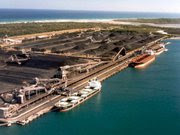
Enter the 280,815 DWT Ore Fabrica, previously known as the crude oil tanker, Front Duchess. This vessel was converted by China State Shipbuilding Corporation from the crude oil tanker pictured above, to a specially designed platform based in the Philippines that will allow the transshipment of iron ore from these giant ore carriers, to smaller vessels for follow on transport to China, Taiwan, Japan and South Korea.

The first of these transshipment loads will commence in early February with the arrival of the Vale Brazil and Vale China in Subic Bay.

Citing safety concerns after the VLOC Vale Beijing experienced structural issues in Brazil, China has yet to approve port entry permits. Safety concerns aside however, politics and family connections appear to play an important role in this developing drama as the 388,000 DWT Berge Everest was allowed to unload her Brazilian cargo of ore in Dalian recently.

The Berge Everest, despite being on long term charter to Vale, is owned by Berge Bulk an offshoot of Singapore based BW Maritime that is controlled by the Sohmen family, the descendants of the late mainland born shipping magnate Pao Yue kong.

(sourced Gcaptain.com)

Monday, August 8, 2011

Oil falls more than $2 after US credit rating

Mon Aug 8, 2011

By Manash Goswami

SINGAPORE (Reuters) - Crude fell more than $2 a barrel on Monday after rating agency Standard & Poor's downgraded the United States' top-tier credit rating, raising concerns on the outlook for demand in the world's biggest oil consumer.

U.S. oil fell as low as $83.68 a barrel and traded at $84.22 by 0143 GMT, posting losses for five of the last six trading sessions. Brent slumped as much as $106.20, the lowest since the close of June 27, and traded at $106.54.

Markets are on edge following the U.S. credit downgrade to AA-plus and fears of Europe being unable to battle a debt crisis and prevent it from spreading. Aiming to calm investors, the Group of Seven major industrialised nations expressed trust in U.S. Treasuries and steps by the European Central Bank to halt financial market contagion.

"The cost of borrowing will increase in the U.S. as a result of the downgrade," said Ken Hasegawa, a commodity derivatives manager at Japan's Newedge brokerage. "The U.S. will have to tighten money flow to reduce its deficit. That may lower consumption by people in the country, reducing oil demand."

Investors on Monday struggled to ascertain the impact of the downgrade on the financial system, from mortgages to banks to markets that rely on U.S. Treasuries for collateral.

NO RATING IMPACT ON ASIAN SOVEREIGNS

Standard and Poor's sought to assure global investors that its downgrade of the U.S. would have no immediate impact on sovereign borrowers in the Asia-Pacific. But the agency said a fresh global financial crisis could hurt some Asian sovereigns harder this time around.

Asian shares fell and the dollar languished near a record low against the Swiss franc, while gold powered to another record just short of $1,690 an ounce.

U.S. stock index futures opened sharply lower in the first trading in domestic equities after the downgrade on concerns the move was likely to raise borrowing costs for the American government, companies and consumers.

Many downplayed the likelihood of the sort of financial contagion experienced when Lehman Brothers went under in September 2008. Few had expected it to have to file for bankruptcy, and few were prepared for the fallout.

"Yes, the downgrade has some implications, no doubt about it," said Jonathan Barratt, managing director at Commodity Broking Services in Sydney. "But it is one ratings agency, and it is nothing too much. The fall in prices is a knee-jerk reaction by Asia."

Japan's Finance Minister Yoshihiko Noda said that market trust in the dollar and U.S. Treasuries has not wavered in the wake of the downgrade.

U.S. Treasury debt is as safe as it was before the downgrade and Congress' "damaging" debate over raising the country's debt limit, Treasury Secretary Timothy Geithner said on Sunday. He also criticised the move.

U.S. 30-year long bond futures fell moderately at the start of electronic trade in Asia. The 30-year T-bond future fell 12/32 in price to 131-26/32.

In Europe, political and financial leaders gave their first sign of readiness to battle the debt crisis with the European Central Bank signalling it would start buying Italian and Spanish debt.

On Friday, Brent settled at $109.37 a barrel, slumping 6.3 percent for the week. U.S. oil settled at $86.88 a barrel, having bounced off a previous session trough of $82.87, the lowest since November 26, 2010.

Brent would revisit the August 5 low of $104.30 per barrel, as a medium-term downtrend is expected to develop more, while a bearish target at $81.35 is unchanged for U.S. oil as a wave "3" of a downward wave "C" has not been completed, according to Reuters technical analyst Wang Tao. (sourced Thomson Reuters)

Wednesday, March 9, 2011

Petrol prices hit record in France


Mar07, 2011 06:47 pm

Petrol prices rose to a record high in France last week, with a litre of 95-octane petrol costing on average 1.5067 euros, according to information published Monday by a government agency.

he price, equivalent to $7.97 per US gallon, beat the previous record set in June 2008 of 1.4971 euros.

A litre of 98-octane petrol rose to an average of 1.5417, also beating the record of June 2008 of 1.5326 euros ($8.15 per US gallon).

The price of diesel, which accounts for 78 percent of sales in France, rose to an average of 1.3513 euros per litre ($7.15 per US gallon), some 10 cents below its record price.

Petrol prices at the pump have risen as the price of crude oil has jumped on markets due to tension and unrest in north Africa and the Middle East.

On Monday, New York's main contract, light sweet crude for delivery in April, hit $106.95 a barrel -- the highest level since September 2008.

In London, Brent North Sea crude for April rose 88 cents to $116.85.

The prices are still far below the record $147 per barrel set in 2008.

Wednesday, March 2, 2011

Macroeconomic indicators - Index of six core industries for January 2011

Wednesday, 02 Mar 2011
The Index of Six core industries having a combined weight of 26.7% in the Index of Industrial Production with base 1993-94 stood at 295.6 (provisional) in January 2011 and registered a growth of 7.1% (provisional) compared to 9.8% registered in January 2010. During April-January 2010-11, six core industries registered a growth of 5.6% (provisional) as against 5.5% during the corresponding period of the previous year.
Crude Oil
Crude Oil production (weight of 4.17% in the IIP) registered a growth of 10.8% (provisional) in January 2011 compared to a growth rate of 9.8% in January 2010. The Crude Oil production registered a growth of 11.9% (provisional) during April to January 2010-11 compared to (-) 0.1% during the same period of 2009-10.
Petroleum Refinery Products
Petroleum refinery production (weight of 2.00% in the IIP) registered a growth of 8.7% (provisional) in January 2011 compared to growth of 3.8% in January 2010. The Petroleum refinery production registered a growth of 2.4% (provisional) during April to January 2010-11 compared to (-) 0.5% during the same period of 2009-10.
Coal
Coal production (weight of 3.2% in the IIP) registered a growth of (-) 1.2% (provisional) in January 2011 compared to growth rate of 5.4% in January 2010. Coal production grew by 0.8% (provisional) during April to January 2010-11 compared to an increase of 8.0% during the same period of 2009-10.
Electricity
Electricity generation (weight of 10.17% in the IIP) registered a growth of 9.3 % (provisional) in January 2011 compared to growth rate of 6.4% in January 2010. Electricity generation grew by 5.0% (provisional) during April to January 2010-11 compared to 5.9% during the same period of 2009-10.
Cement
Cement production (weight of 1.99% in the IIP) registered a growth of 1.8% (provisional) in January 2011 compared to 12.4% in January 2010. Cement Production grew by 4.1% (provisional) during April-January 2010-11 compared to an increase of 11.1% during the same period of 2009-10.
Finished (carbon) steel
Finished (carbon) Steel production (weight of 5.13% in the IIP) registered a growth of 8.2% (provisional) in January 2011 compared to 16.8% (estimated) in January 2010. Finished (carbon) Steel production grew by 7.8% (provisional) during April-January 2010-11 compared to an increase of 5.7% during the same period of 2009-10.

Sunday, February 27, 2011

Yuan rises on speculation China to permit gain to ease inflation


Sunday, 27 Feb 2011

China yuan gained after sliding recently by the most this month, on speculation the government will permit more appreciation to contain inflation.

Industry data show the yuan advance came as the US Dollar Index traded on ICE futures in New York a gauge of the greenback strength dropped for the first time in three days. Crude oil prices jumped 11% in the past two days in New York on concerns a week long uprising in Libya will disrupt supplies. China imported 54% of the oil it used in 2010.

Mr David Cohen head of Asian forecasting at Action Economics in Singapore said “Beijing sees the usefulness of appreciation as part of its policy to contain inflation, along with higher interest rates and reserve requirement ratios. Appreciation is another way to help contain price pressure from global commodities.”

According to the China Foreign Exchange Trade System the yuan gained 0.09% to 6.5743 per dollar as of 4:30 PM in Shanghai from 6.5803. It fell 0.21 percent retreating from a 17 year high of 6.5654 reached February 21. The central bank set its daily reference rate 0.09% weaker at 6.5828.

Thursday, January 27, 2011

Sasol says rand strength has big impact

Thursday, Jan 27, 2011

DAVOS, Switzerland (Reuters) - South Africa's oil from coal company Sasol said it was speeding up its move into gas and that rand strength was having a big impact on its business.
CEO Patrick Davies told Reuters Insider in an interview at the annual meeting of the World Economic Forum that rand strength had made the company sharper and forced it to cut costs.

Sasol was formed 60 years ago to turn South Africa's coal reserves into liquid fuels. Davies said it was now "putting the foot on the accelerator" on its move into gas.
It agreed last month to pay $1.03 billion for a half share of a Talisman Energy shale gas property.

The deal is Sasol's first push into the shale gas plays whose abundance has transformed North America's natural-gas business by driving down prices. It could lead to the introduction of the South African company's gas-to-liquids technology.(sourced:reuters)

Saturday, January 15, 2011

Energy commodity report: January 14, 2011

January 14, 2011

All prices unless otherwise stated are for the close of January 13.2012 baseload German power: €53.25/MWh, down 1.11%2012 CIF ARA Coal: €119.32/t, down 0.51%Front month UK natural gas: GBp56.35/therm, down 0.79%EU emission allowances (EUAs) for December 2011 delivery: €14.28/t, up 0.21%Certified Emission Reduction(s) (CERs) for December 2011 delivery: €10.90/t, down 0.27%Brent crude oil futures for front-month 2010 delivery: US$98.45/bbl, up 0.4% as of GMT 8:45, January 14WTI crude oil futures for front-month 2010 delivery: US$90.97/bbl, down 0.3%, as of GMT 8:45 January 14
Latest buzz
Oil traders experienced a muddled day of trading on Thursday, as an increase in new jobless claims in the US, weighed on the market, causing benchmark crude for February delivery on the NYMEX to hit an intraday low of US$90.75/bbl and prompting profit-taking. As the day went on, a stronger euro, pushed up by a €5bn Spanish debt auction, pushed the US dollar lower, allowing the commodity to recover most of its earlier losses. As a result, oil settled down US$0.46 at US$91.40/bbl, after an intraday high of US$92.37/bbl. First-time claims for unemployment benefits rose by 35,000, the largest weekly increase seen in six months, to 445,000 in the week ended January 8.e
As of writing, Brent crude has returned to the same level it was trading at this time yesterday. The spread between New York and Brent crude is now an impressive US$7.87/bbl, owing much to a leak on the Trans Alaska pipeline, given that Brent is delivered by sea, while WTI is physically delivered via pipeline to the landlocked hub at Cushing, Oklahoma.
Alyeska Pipeline Service Co intends to shut the Trans Alaska pipeline system today to install a by-pass and stop a leak on the line. The pipe will close at 18.00h and may be shut for as long as 48 hours, according to a statement from the company. During this time, a section will be put in so that crude can be transported around a breach at pump station 1. The pipeline was temporarily restarted on January 11, to prevent freezing within the pipe. The situation has forced BP, ConocoPhillips and Exxon Mobil to shut-in 95% of their production from the North Slope area. As of mid-day Thursday, the pipeline was transporting crude at a rate of around 320,000bbl a day, roughly half its full capacity.
Norway has dramatically cut its estimate of undiscovered or unproven oil reserves, by 21%, from 20.8bnbbl boe to 16.4bn boe, compared to 2006 after disappointing drilling results. Oil production fell in 2010 by 10% YoY, while proven oil reserves have fallen from 5.2 to 4.8bnm3. The Norwegian Petroleum Directorate (NPD) said that the discovery of proven reserves equal to around 400mm3 of oil equivalent over the past five years had contributed to the revision, together with “disappointing drilling results” in deep-water areas of the Norwegian Sea. Norwegian oil production is now expected to fall by 5.8% in 2011. The news has prompted oil officials to call for more debate over opening up the Lofoten region in the Arctic to oil exploration. The region currently remains off limits due to environmental concerns and its importance to the fishing industry. On the positive side, natural gas sales rose by 3% in 2010 to 105.6bnm3 and are expected to rise to 109.1bn3 in 2011 and 112.2bnm3 in 2015. Some positive potential comes from an agreement made between Norway and Russia over the much disputed Barents Sea. Should this area be opened up for exploration, there is a chance that large discoveries could be made once more.
Natural gas for February delivery on the NYMEX dropped by US¢13, or 2.7%, to US$4.41/MBtu on Thursday, weighed down by the combination of disappointing US employment data and a distinct lack of bullish sentiment on the global financial markets. The news that 138bnft3 of gas was withdrawn from storage in the week ending January 7 (according to a EIA report), appears to have little impact. The drawn-down was slightly below some analysts’ expectation, but was still significantly above the five-year average of 108bnft3. Also weighing on the market was the growing consensus among forecasters that the US will see a general shift to milder weather towards the end of this month, which will reduce heating demand.
Australian thermal coal prices, traded at close to US$140/t on Thursday, with support coming from the flooding situation in Queensland. Thermal coal on the globalCOAL Newcastle index for the week to date, finished at US$138.58/t, up US$9.08 WoW. The index hit a high of US$141.25/t on Monday and traders have reported that recent spot prices have climbed as high as US$143.50/t. Meanwhile, India’s coal minister, Sriprakesh Jaiswal, has said that Indian coal imports may double over the course of this year to 104Mt in the year ending March 2012, while Helen Lau at UOB Kay Hian Ltd has predicted that Chinese purchases of international coal could rise by 30%, to 210Mt in 2011. Yesterday saw South Korea’s five utilities look for 1.2Mt of thermal coal in the spot market for February and March to reduce the risk from further shipment delays. Buyers have been turning to Indonesia, Colombia and South Africa to make up for the shortfall, but the latter two countries are suffering from supply disruptions themselves due to weather and logistical constraints.
Yesterday saw prompt physical coal prices for delivery into Europe fall by around US$2.00/t. Two March delivery DES ARA cargoes traded via brokers at US$127.00/t and US$127.50/t, down US$2.00, while a March DES ARA cargo was bid at US$127.00 and offered at US$127.50, also down US$2.00, according to Reuters.
Over in China, thermal coal with a heating value of 5500kCal/kg traded at CNY780-790/t (US$118-119.68/t), while inventories at the port of Qinhuangdao fell by 1.3% to 6.95Mt on week. The situation in Australia has prompted the return of some Chinese coal miners, such as Shenhua Group and China National Coal Group to the overseas spot market. They appear to be exercising some restraint in terms of volume in an effort to not depress prices. Unfortunately for the rest of the market, a 10% export tax, means that such companies are only interested in selling premium bituminous coal, further limiting volumes.
The Dec11 EUA contract hit an intraday low of €14.17/t, prior to the UK government’s auction of 4.4M EUAs. The auction cleared at €14.00/t with a cover ration of 6.61. The news, released just after 10:00am GMT, caused the contract to hit an intraday high of €14.40/t, before a weakening energy complex fuelled bearish sentiment. Yesterday saw the issuance of 4.23M CERS to 45 CDM projects, pushing down the value of all CER contracts. The Dec11 CER-EUA spread widened by €0.05 to -€3.38 and the Dec12 spread widened by €0.08 to -€3.89.
Source: IFandP Newsroom