Google Website Translator Gadget

Showing posts with label Weather news. Show all posts

Monday, May 9, 2011

Japan's Hamaoka nuke plant closed over quake fears

Monday09, 2011 20:38:10 |English.news.cn

TOKYO, May 9 (Xinhua) -- Chubu Electric Power Co. President Akihisa Mizuno said Monday that the company agreed to a request last week by Japanese Prime Minister Naoto Kan to suspend the Hamaoka nuclear power plant in Shizuoka Prefecture for safety concern.

"We decided at today's final extraordinary board meeting to suspend operation of the No. 4 and 5 reactors and postpone restarting of the No. 3 reactor," Mizuno told a news conference.

The utility, Japan's third biggest, decided that the firm will mothball reactors No. 1 and No. 2 and idle the No. 4 and No. 5 reactors at Hamaoka plant, which serves central Japan, following the prime minister's direct request coupled with a government report indicating an 87 percent likelihood of a magnitude-8 earthquake or higher striking the area within 30 years.

Naoto Kan asked Chubu Electric Co. to stop operation in Hamaoka on Friday, quoting safety concerns that the nuclear power plant lacks medium- to long-term measures for protection against disasters, such as embankments.

Naoto Kan welcomed the decision, saying the government will make utmost efforts to avoid power shortage in the central region of the Honshu island, an economic power house of Japan.

Japanese government reached the conclusion to suspend Hamaoka plant after evaluating the country's 54 reactors for quake and tsunami vulnerability after the magnitude 9.0 earthquake and ensuing tsunami on March 11 devastated the Pacific coastal regions of northeastern Honshu.

Japan's Minister of Economy, Trade and Industry Banri Kaieda said the country's other nuclear plants will not be suspended and the ministry is ready to financially support Chubu Electric Power Co. over Hamaoka.

The company continued operating the 1,137-megawatt No. 4 reactor and the 1,380-megawatt No. 5 reactor at Hamaoka plant after the March 11 disaster, which crippled Tokyo Electric Power Co.'s Fukushima No 1. nuclear plant and led to Japan's worst nuclear crisis.

The 1,100-megawatt No. 3 unit at Hamaoka has been shut for regular checks since November 2010, while No. 1 and No. 2 reactors are in the process of being scrapped.

The plant sits 190 kilometers southwest of Tokyo on a dangerously active fault-line that seismologists monitor carefully for increasing seismic activity.

Concerns about electricity shortages in summer when demand peaks follwoing a shutdown of Hamaoka will purportedly be offset by increased output by non-nuclear power generation.

The Hamaoka plant in Shizuoka, populated by 3.75 million people, is known as "the most dangerous" nuclear power plant in Japan due to its aged reactors, proximity to a massive fault-line and coastal area and inability to sustain a sizable earthquake similar to the quake and tsunami that crippled Fukushima No.1 plant on March 11. (sourced xinhua)

Monday, April 4, 2011

Tsunami alert issued after Indonesia's 6.7-magnitude quake


Mon, Apr 4, 2011 2:51 AM IST
By Indo Asian News Service | IANS

Jakarta, April 4 (IANS) A tsunami alert was issued early Monday after a 6.7-magnitude quake jolted the Java region of Indonesia, Xinhua reported.

The quake struck at 3.06 a.m. The epicentre was at a depth of 24 km, the US Geological Survey said. The quake-hit region is about 400 km southeast of Jakarta.

Wednesday, March 30, 2011

6.4-magnitude earthquake hits off east coast of Japan's Honshu

Wed Mar30, 2011 14:18:31

BEIJING, March 30 (Xinhua) -- An earthquake measuring 6.4 on the Richter scale jolted the waters off the east coast of Honshu, Japan at 13:29 p.m. Beijing Time Wednesday, according to the China Earthquake Network Center.

The epicenter, with a depth of 30 km, was monitored at 36.2 degrees north latitude and 142.4 degrees east longitude, the center said in a statement.

Tuesday, February 22, 2011

Pilbara region takes cover as cyclone hits home


By Andrew Burrell
February 23, 2011 12:00AM

MAJOR petroleum and mining projects in Western Australia's Pilbara region were forced to suspend operations for the third time in a month yesterday as Tropical Cyclone Carlos battered the coast with 140km/h winds and heavy rain.

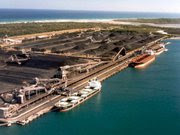
Loading of ships for export was halted after authorities at Port Hedland, which is used by iron ore miners BHP Billiton and Fortescue Metals Group, suspended operations due to the cyclone.

Plants across the Pilbara have experienced heavy rains that closed rail lines and roads.

A spokeswoman for Woodside Petroleum said production from its Enfield oilfield and Cossack Pioneer floating facility had stopped, while production from its Vincent oilfield remained shut-in due to planned maintenance.

Woodside chief executive Don Voelte said on Monday that plans for the $14 billion Pluto project near Karratha to be completed by August could be delayed by the wild weather in recent weeks, including Tropical Cyclone Bianca that hit the Pilbara last month.

The cyclones caused 20 days of lost production, which might not be recoverable, Mr Voelte said. "At this late stage of the project, it might be hard to make up any or all of that time," he said.

"It's a fact of life -- it's raining and raining and raining up there."

Apache Corporation said it halted production at its Stag and Van Gogh fields off Western Australia before Carlos, but output at Varanus Island continued.

On Monday, Rio Tinto warned that shipping volumes were likely to be affected this quarter as cyclones Carlos and Dianne hampered its operations.

Dianne moved further off the coast this week.

Fortescue said it was waiting to hear from the harbourmaster at Port Hedland as to when the port would reopen.

A spokeswoman for the port said it remained closed and on "yellow alert", although there was an expectation operations might resume late yesterday.

Smaller mine company Murchison Metals said its Jack Hills iron ore project in WA's mid-west had been suspended for at least 14 days because of heavy rain and floods, forcing at least two export shipments set to leave the port of Geraldton next month to be delayed.

(sourced:The Australian, Additional reporting:Dow Jones Newswires)

Tags:BHP Billiton, Australia's Fortescue Metals Group, Murchison Metals, Port of Geraldton, Australian iron ore shipment, raw material

Tuesday, February 1, 2011

Australia evacuates coastal cities in path of big cyclone

* Cyclone may generate winds of up to 280 kph
* Forecasters warn cyclone may sweep deep inland
* Evacuations under way in three cities
* Mines, rail lines closed; sugar crops could be badly hit
By Rob Taylor

CANBERRA, Feb 1 (Reuters) - Australia evacuated thousands of people from its northeast coast on Tuesday as a cyclone rivalling Hurricane Katrina bore down on tourism towns and rural communities, with officials saying it could even threaten areas deep inland that were ruined by floods last month.
Mines, rail lines and coal ports were closed in Queensland state as Cyclone Yasi headed towards the coastline. Up to a third of Australia's sugar crop was also under threat, officials said.
"This storm is huge and life threatening," Queensland Premier Anna Bligh said, warning the system was still intensifying and picking up speed on its path from the Coral Sea, with destructive winds expected on Wednesday morning.

Cyclone Yasi is expected to generate winds of up to 280 kph (175 mph) when it hits the northern coast of tropical Queensland state early on Thursday, matching the strength of Katrina, which devastated New Orleans in 2005.
With a strong monsoon feeding Yasi's 650 km-wide front, the storm was also expected to maintain its intensity long after smashing into the coast and could sweep inland as far as the outback mining city of Mt Isa, some 900 km (600 miles) inland.
More than 400,000 people live in the cyclone's expected path, including the cities of Cairns, Townsville and Mackay, which are also key tourist areas and take in Australia's Great Barrier Reef.
Queensland, which accounts for about a fifth of Australia's economy and 90 percent of steelmaking coal exports worth about $20 billion a year, has had a cruel summer, with floods having swept the eastern seaboard over the past month, killing 35 people.
"There's no time for complacency," said Mike Brunker, mayor of the Whitsunday area near the Great Barrier Reef. "People in low-lying areas are evacuating to friends and family or, if they have to, leave town."

Satellite radar images showed Yasi as a massive storm covering almost the entire Coral Sea and moving towards Australia from near Vanuatu.
Among the areas in its path is the small tourist area of Mission Beach, which was flattened by Cyclone Larry in 2006.
"It's a beautiful day today, but all of the tourists have now gone and we're just preparing everything for the cyclone," Mission Beach resident Elvira Montgomery told Reuters.
"They are warning of a four metre tidal surge, so everything might all end up under water."
Authorities said Cyclone Yasi could be the most destructive cyclone to hit the area. A sugar industry official said it could threaten around a third of the state's sugar cane crop.
Island resorts in the Whitsundays and parts of the tourism hub of Cairns and military town of Townsville were being evacuated along with other areas in the danger zone, between Cooktown in the north and near Mackay, a port, further south.

Military C-130 transport aircraft also evacuated the main hospital in Cairns. Extra commercial flights were scheduled to cope with an expected exodus of holidaymakers and residents.
Police were also empowered to forcibly move people from danger zones.
"This is not a system that's going to cross the coast and rapidly weaken out," Bureau of Meteorology senior forecaster Gordon Banks said, warning winds could reach up to 280 kph and the storm could reach Mt Isa, 900 km inland.
"We could see this system pushing well in across northern Queensland as a significant tropical cyclone with damaging winds and very heavy rainfall," Banks said.

COAL INDUSTRY ON ALERT -- AGAIN
Queensland's coal industry, only just recovering from recent record floods, went back on alert on Tuesday, with at least one major mine closing down temporarily and rail operations suspended as the industry braced for the cyclone.
The country's largest coal freight company, QR National , temporarily closed two rail networks: the major Goonyella network, feeding into the export terminals of Dalrymple Bay and Hay Point, and its smaller Newlands line taking coal to Abbot Point, a company spokesman said
Global miner Rio Tinto shut its Hail Creek coal mine with the approach of the cyclone.
Queensland's coal mines are mostly inland and are still struggling to pump water out of their pits after flooding.

The Queensland Resources Council, an industry body, estimated coal miners would take until March to return to normal, even without the impact of cyclones.
Bligh said Yasi had the potential to cause powerful and deadly flash flooding in coastal areas. Most of the state's major coal ports were temporarily closed to shipping.
But she said the storm track had shifted slightly north, meaning flood devastated and coal mining areas of central Queensland may escape the worst of cyclonic rains.
"If there is any silver lining here, the movement of the cyclone slightly north has meant that when it travels west and moves inland, it is less likely to drop all of that massive rainfall into the central Queensland catchment areas that have already experienced flooding," Bligh said.
Last month's floods swamped around 30,000 homes, destroyed roads and rail lines and crippled Queensland's coal industry, with up to 15 million tonnes of exports estimated to have been delayed into the second half of this year.
Cyclone Yasi is expected to classified a "category 4" by the time it reaches the coast, similar to Cyclone Larry which hit the town of Innisfail in 2006, levelling sugar crops and causing A$1.5 billion worth of damage.
(Additional reporting by James Grubel in CANBERRA, Amy Pyett and Bruce Hextall in SYDNEY and Sonali Paul in MELBOURNE; Editing by Ed Davies and Sanjeev Miglani($1 = 1.003 Australian Dollars, sourced:reuters)

Sunday, January 30, 2011

Australian coal port shuts ahead of cyclone

CANBERRA Jan 30 (Reuters) -
Australia's largest coal export terminal of Dalrymple Bay shut down operations on Sunday due to an approaching cyclone, which is expected to hit the region early on Monday.
The closure is the latest disruption to coal exports from Queensland and follows devastating summer floods across eastern Australia, which killed at least 35 people, swamped 30,000 homes, forced mines to close and destroyed roads and rail lines.

Australia's weather bureau said tropical cyclone Anthony was gaining strength to a category two cyclone as it approached the northern Queensland coast, and would lead to high tides, rough seas and destructive wind gusts.
The cyclone is due to hit land between the northern Queensland towns of Townsville and Mackay, prompting the closure of the export harbour around the Dalrymple Bay terminal.
"The harbour master has locked the port down as of 10 a.m. this morning," said Dalrymple Bay spokesman Andrew Garratt.

"We would be hopeful of being in a position to be out loading again tomorrow morning, but that will be determined by just how rough the seas are," he said.
Australia's floods disaster has already piled up pressure on government finances and Prime Minister Julia Gillard, who is struggling to win public support for her recovery package, which included a new flood tax.

The Queensland state government on Friday said it estimated the floods cut up 15 million tonnes from steel-making coal exports from the financial year ending June 30, 2011.
Townsville mayor Les Tyrell said the area was well prepared for cyclone Anthony and more heavy rain.
"We are fairly fortunate at the moment. Our dams are certainly full but our rivers and streams are now empty to some extent from the rain we had," he told Australian media.
Authorities are also watching another tropical storm near Vanuatu, which could form a cyclone and hit Queensland late this week.
The prime minister on Sunday urged people in north Queensland to prepare for the cyclone and listen for weather warnings.

"We're all made of tough stuff and we'll get through this but this is another big cruel blow coming on top of what has been a summer of tragedy already," Gillard told reporters.
(Reporting by James Grubel; sourced : reuters)

Friday, January 14, 2011

Commodities-Climate & Weather news; 2-week heavy rain alert for north Australia

Jan. 13, 2011
The prevailing La Nina event, blamed for triggering record-breaking rains over Australia, may be just peaking and is quite sometime away from a wind-down.
Northern Australia is likely to experience above average rainfall for at least another week or two, according to the Bureau of Meteorology (BoM), the national forecaster.
ACTIVE TROUGH
The potential for tropical cyclones to form in the surrounding seas will also remain at a moderate to high level whilst the Australian monsoon trough is active in the area.
La Nina refers to a cooling event in the central and east equatorial Pacific, with strong winds pushing warm waters towards Australia and the adjoining west Pacific.
The warm waters fuel convection and sets up thunder clouds, which in turn breed tropical storms and cyclones.
The December to March Australian monsoon is a successor event to its better known northern hemisphere counterpart, the Indian or Asian monsoon.
Studies have shown that preceding Australian conditions may have virtually had no significant correlation with succeeding Indian conditions.
But comparable Indian conditions have shown significant correlations with many succeeding Australian regional values.
For instance, India saw some heavy to very heavy rains batter the country in what was a linear extension of the very same La Nina conditions in the Pacific.
That such strong wet weather should have come virtually on the heels of a record-smashing drought underwritten by the year 2009 El Nino year had made scientists and researchers sit up and take notice.
Nobody had bargained for the scale and intensity of the rain fury unleashed over the continent in the far-east.
But researchers at the Tokyo-based Regional Institute for Global Change (RIGC) had flagged the possibility of ‘stronger than usual La Nina' well in advance.
And this is what has proved now, with the BoM itself saying in its latest update that a major La Nina event continues to affect the Pacific Basin.
Long-range models surveyed suggest that this event may be at its peak, and will persist into the southern hemisphere autumn.
But RIGC researchers are of the view that the event could last through the whole of this year even while progressively weakening and may peter out in 2012 only.
THIRD WETTEST
Previous strong La Nina events, such as those of 1974 and 1955, have also been associated with widespread and severe flooding in eastern Australia.
Sea surface temperatures off the Queensland coast in recent months have been at or near record levels.
The current event has contributed to 2010 being Australia's third wettest year on record, and Queensland having its wettest December on record.

Source: www.thehindubusinessline.com ByVinson Kurian,Thiruvananthapuram