Sun, Oct23, 2011
BEIJING, Oct. 23 (Xinhua) -- China's coal consumption posted steady growth in the first three quarters, with an increase of thermal coal consumption in late September after three consecutive months of decline, according to the country's top economic planner.
China consumed 2.28 billion metric tons of coal in the first nine months, up 10.3 percent year-on-year, the National Development and Reform Commission (NDRC), China's top economic planner, said in a statement on its website Thursday.
Coal shipped via railway and ships in the first three quarters totaled 2.17 billion metric tons, according to NDRC.
As the world's largest coal producer and consumer, China relies on coal to fuel its economy as about four-fifths of electricity comes from thermal power plants.
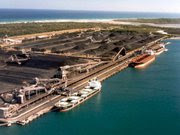
In terms of inventory, coal stocks at five major ports expanded by 980,000 metric tons from the end of September to reach 12.51 million metric tons on Oct. 18.
Major thermal power plants added 6.31 million metric tons to their coal reserves, bringing the current total to 70.86 million metric tons, which can meet electricity generation demands for an average of 20 days, said NDRC.
Coal imports surged 25.1 percent from a year earlier to 19.12 million metric tons in September, reversing a decline in coal imports in the first eight months.
China's imports grew 1.9 percent year-on-year to 123 million metric tons from January to September, while exports totaled 12.12 metric tons in the period.
According to the NDRC data, China has become a net importer of coal in the first nine months, with a net import of 111 million metric tons.
(sourced xinhua)
Showing posts with label NDRC. Show all posts
Showing posts with label NDRC. Show all posts
Sunday, October 23, 2011


Tuesday, March 8, 2011
China targets 3.5% cut in energy, carbon intensity in 2011
Tue,Mar08, 2011
BEIJING, March 8 (Xinhua) -- China aims to reduce energy consumption per unit of GDP by 3.5 percent in 2011 from the level a year ago, an official with the country's top planner said on Tuesday.
Carbon dioxide emission is also set to be slashed by 3.5 percent, said Li Pumin, spokesman of the National Development and Reform Commission (NDRC), which is in charge of energy-saving work.
Emissions of major pollutants including sulfur dioxide and (COD) chemical oxygen demand will fall 1.5 percent, Li told an online interview.
Chinese government vowed to make its economy greener in the forthcoming five years after brisk economic growth at the cost of heavy pollution and resource use proved to be unsustainable.
According to the draft 12th Five-year Plan (2011-2015) for China's economic and social development, the nation aims to reduce energy consumption per unit of GDP by 16 percent in the five years to 2015. Carbon dioxide emission will drop by 17 percent.
Monday, March 7, 2011
China gives environmental nod to Sasol CTL project
Mon Mar 7, 2011 5:21am GMT
BEIJING (Reuters) - China granted initial environmental approval to an $8.8 billion project by South African petrochemical firm Sasol and China's top coal producer Shenhua Group to turn coal into fuels.
The environmental clearence put the project, potentially one of the largest foreign investments in China, a step closer to final approval from the top economic steering body, the National Development & Reform Commission (NDRC), after nearly a decade of talks between the two companies.
The project, to be built in north China's Ningxia region, plans to make 3.16 million tonnes of diesel and 655,500 tonnes of naphtha a year, according to a post published on the website of China's Ministry of Environmental Protection (www.mep.gov.cn).
After backing coal-to-liquid (CTL) investments as a way of improving energy security and easing its growing dependence on foreign oil, China went cold on the technology in 2008, cancelling dozens of projects amid concerns about high costs and the impact it would have on scarce local water supplies.
The country's massive coal industry has also been developing its own coal liquefying technology, which has become a drag for the government to rush approving projects like this one by Sasol, which emerged from discussions with Shenhua back in 2000.
"The Chinese government obviously favours domestically grown technology when its comes to approvals, given that Shenhua already started a similar plant based on pure Chinese know-how," said a Beijing-based oil industry official.
Shenhua Group, parent of Shenhua Energy Co Ltd, has built its first CTL plant in the northern Inner Mongolia region expected to reach 3 million tonnes a year by 2015.
"It seems a big reason why the project got the final go-ahead was the potential for technology transfer from Sasol to Shenhua. Its a very important consideration given how new this sector is in China," said Shi Sijin, an analyst at Hawker Capital.
But Shi said the approval shouldn't be interpreted to mean Beijing is shifting its cautious position on the sector and that the Chinese government is unlikely to encourage more CTL projects.
Sasol CEO Pat Davies told analysts in December that the firm was expecting a positive outcome from the Chinese government early this year and hoped to make the investment decision during this calendar year. (sourced:Thomson Reuters)
Tags : CTL, coal liquefying technology, Hawker Capital, coal, coal to liquids project
Saturday, March 5, 2011
China's NDRC confirms Hebei Steel will quit Caofeidian steel project
Mar 5, 2011
Hebei Province-based Chinese steelmaker Hebei Steel Group recently announced its intention to withdraw from the project for the construction of a steel production base in Caofeidian, Hebei Province, and this has now also been confirmed by China's National Development and Reform Commission (NDRC).
Hebei Steel plans give up its stake in the project, in which it holds a 49% share. Beijing-based Shougang Steel Group, which holds the other 51%, has stated that while it was intending to secure the whole stake being sold by Hebei Steel it will be unable to afford to do so.
It is now widely speculated that Kailuan Group, the largest coal enterprise in Hebei Province, will acquire part of the stake being sold by Hebei Steel, while Shougang Steel will acquire the remainder.
In 2011, Kailuan Group targets total raw coal production of 70 million tonnes and an operating revenue exceeding 100 billion yuan.
Influenced by weak demand in the market, the Caofeidian joint venture may suffer large losses, while main management positions and operations were controlled by Shougang Group. As a result, Hebei Steel Group had decided to withdraw from the joint venture, the insider stated.
Monday, February 21, 2011
Coal capacity expands at Inner Mongolia and Shanxi
Feb 21, 2011
North China’s Inner Mongolia Autonomous region that produced 787mt last year is to raise capacity to 900 million tonnes in 2011, while coal-rich Shanxi province with an output of 737 million tonnes in 2010 will achieve a 850 million tonnes of capacity this year, announced the National Development and Reform Commission on Feb 11.
Local coal agencies expect capacities to be further lifted to 1 billion tonnes in Inner Mongolia by 2015, but in Shanxi a marginal increase to 960 million tonnes is projected.
Inner Mongolia produced 69.6 million tonnes in Jan, up 26.7% from the same month of last year, but down 21.8% from Dec, while Shanxi mined 58.17 million tonnes, decreasing 4.7% year on year and plunging 18.5% month on month.
The NDRC predicts a slowdown in coal consumption growth this year due to environmental pressures but did not give details.
(sourced:China Coal Times)
Thursday, January 27, 2011
China ports see coal stock at 24Mt by end-2010
Jan 26, 2011
Coal stockpiles at China’s main loading ports amounted to 23.73 million tonnes at the end of Dec 2010, surging 65.3% year on year and rising 6.2% month on month, disclosed the National Development and Reform Commission (NDRC) on Jan 24, Yicai Daily reported.
Meanwhile, China’s railways transported a total of 1.4 billion tonnes power coal in 2010, jumping 23.1% on year, the NDRC said.
Earlier, the Ministry of Railways said that coal haulage via railways reached nearly 2 billion tonnes in 2010, up 14.2% year on year.
Statistics from the Ministry of Communication showed China’s major ports shipped a total of 556 million tonnes coal in 2010, rising 21.6% from that in 2009. Of this total, 538 million tonnes was for domestic trades, up 24.1% from a previous year, and 18.1 million tonnes for foreign trade, falling 25.2% year on year.
(sourced:en.sxcoal.com)
Friday, January 14, 2011
Shanxi Minmetals Industrial & Trading obtains approval for Mexican project
Tuesday, 04 January 2011 13:19:35 (GMT+2)
The development and reform commission of China's Shanxi Province has announced that local trading firm Shanxi Minmetals Industrial and Trading Co., Ltd (Shanxi Minmetals Industrial and Trading) has received approval from China's National Development and Reform Commission (NDRC) for its new iron ore project in the southern state of Jalisco in Mexico.
The project, which will involve both open-pit and underground mining, has estimated total reserves of 58.8 million mt of iron ore, with an annual iron ore output of 1.45 million mt.
Shanxi Minmetals Industrial and Trading signed the agreement to purchase the Mexican project in September 2009, and has since obtained mining rights and enviromental approvals.
Shanxi Minmetals Industrial and Trading mainly exports coke and bauxite, and also processes imported materials including manganese ore, chromium ore and iron ore and exports the processed products. Shanxi Minmetals Industrial and Trading is the third largest coke exporter and fourth largest bauxite exporter in China.
Source:steelorbis.com
Subscribe to:
Posts (Atom)

 Posts