Monday, 30 May 2011
According to data from industry consultancy Mysteel, inventories of imported iron ore at major Chinese ports jumped 10.7% to reach a record 92.45 million tonnes this week,
A shipping broker in east China's Shandong province said that "Many steel mills are reluctant to take their imported tonnages and are leaving their stockpiles at ports for a few days longer as they try to shun imported ore and use domestic ores to lower their costs.”
Volumes from the three major importing countries, Australia, India and Brazil, all rose by smaller margins over the week, indicating that a larger proportion of shipments have been delivered from other countries.
(sourced Thomson Reuters)
Monday, May 30, 2011


Angang Group inks pact with 3 private steel mills
Monday, 30 May 2011
Angang Iron and Steel Group Co Ltd has inked restructuring agreement with three private owned steel enterprises on May 26 in Anyang city, which will further revitalize the steel resources and improve concentration in steel industry in Henan province to strengthen its overall capacities of the steel industry.
1. Fengbao Special Steel Co Ltd
2. Xinpu Steel Co Ltd
3. Yaxin Steel Co Ltd
After restructuring, Angang Group will hold 10% stake in each of the three private owned steel mills whose later development will be integrated into the overall planning of Angang Group.
Mr Wang Ziliang president & GM of Angang Group said “After 50 year development, Angang Group has rapidly grown into a modern steel enterprise with the annual crude steel output capacity surpassing 10 million tonnes, realizing an extraordinary performance of no loss in 32 straight years and achieving net profit of CNY 0.15 billion last year.”
While the three private owned steel mills also formed their unique management model and created good economic returns during the long processes of their development, with their total crude steel capacity arriving at 5 million tonnes and net profit reaching CNY 0.166 billion by the end of last year.
The restructuring this time was approved by State owned Assets Supervision and Administration Commission, adopting the mode of “gradual stock rights integration.
(sourced MySteel)
CISA sees Chinese crude steel demand at 750 million tonnes by 2015
Monday, 30 May 2011
China Iron and Steel Association predicted that the country's annual demand for crude steel will rise to between 670 million tonnes and 750 million tonnes in 2015.
The figures are 11.8% and 25.1% higher compared with the 2010 level.
Mr Luo Bingsheng deputy chief of CISA at a forum said “The prediction based on an assumption that China's economy will register an annual growth rate between 8% and 9% during the 12th Five year Plan period (2011-2015).” (sourced from Xinhua)
NMDC Severstal JV steel project gets under way in Bellary
Monday, 30 May 2011
Deccan Herald reported that National Mineral Development Corporation Limited and Russian steel maker OJSC Severstal have started techno economic and marketing study for the proposed steel plant at Bellary in Karnataka.
Mr Rana Som chairman of NMDC told Deccan Herald that the public sector firm has entrusted MECON to conduct techno economic feasibility study of the project while Severstal has assigned Hutch to conduct marketing study of the products.
Mr Som said that NMDC and OJSC Severstal had floated a 50:50 JV company to set up a 5 million tonnes steel plant in Karnataka. The company had already given INR 55 crore to the Karnataka government for land acquisition which is to be complete by end of 2011.
Both firms would invest a total of INR 9,000 crore in the plant and it will have an initial capacity of 2 million tonne per annum expandable to 5 million tonne per annum.
Mr Som said that the JV would have its captive coking coal mining subsidiary in Russia and iron ore mining subsidiary in India to ensure long term supply of these critical raw materials.
He added that Severstal will share its latest technology for the proposed plant that would focus on producing superior grade steel used in sectors such as automobiles.
(sourced deccanherald)
Sumitomo and Hysco form auto steel pipe JV in Chennai
Monday, 30 May 2011
Sumitomo Pipe & Tube Co Ltd and Sumitomo Corporation announced that they have reached an agreement with Hyundai Hysco Co Ltd of South Korea to establish a joint manufacturing and sales venture in India for automotive steel pipe.
Profile of the Joint Venture
Name: Automotive Steel Pipe India Private Limited
Address: Chennai, Tamil Nadu State
Business description: Manufacturing and sales of automotive steel pipe
Capital: Approximately INR 400 million (JPY 700 million)
Investment amount: Approximately INR 2 billion (JPY 3.6 billion)
Shareholder composition:
Hysco Steel India Private Limited 55% (100% by Hysco)
SPT & SC Investment Co Ltd 45% (74.8% by Sumitomo Pipe & Tube and 25.2% by Sumitomo Corp)
Main facilities:
2 electric resistance welded tube mills
2 draw benches
1 heat treating furnace
3 quenching machines and other equipment
Production items:
Electric resistance welded pipe (carbon steel, stainless steel)
Cold drawn steel pipe
Production capacity: Approximately 4,000 tonnes per month
Number of employees: Approximately 350
Land area: 51,600 square meters
Factory area: 25,800 square meters
Establishment date: August 2011 (scheduled)
Production starts: End of 2012 (scheduled)
India's automotive industry is expanding rapidly thanks to the strong economic growth. With this, demand for automotive steel pipe is expected to expand, with significant growth particularly anticipated for stainless steel exhaust pipes, steel pipes for front forks, door impact beams and other high strength steel pipes as a result of tighter environmental restrictions and the growing demand for safety enhancements.
The joint venture plans to start manufacturing at the end of 2012, targeting Japanese automobile manufacturers, Hyundai Motor Company, the largest automobile manufacture in South Korea, and European and American automobile manufacturers. sourced steelguru
Miang Besar Coal Terminal on Target
Monday, 30 May 11
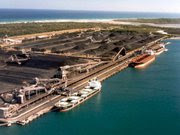
MBCT, to be largest coal terminal in Asia to start construction in Indonesia’s east Kalimantan Island in July 2011 says Mr. John Clark of Miang Besar Coal terminal during coaltrans Asia conference in Bali, Indonesia.
The coal loading terminal can load Chinamax vessels when it completes its construction by end 2013. Each China max vessel can load around 400,000 MT of Iron Ore or 250,000 MT of Coal. The terminal is being designed and constructed to accept bigger LOA vessel such as China max which is 365 meter length and 65 meter width.
According to Mr. John, currently one Chinamax or valemax vessel is operating in the world and around 30 vessels being ordered by Vale. Out of 30 vessels around 16 vessels are under construction.
Miang Besar Coal terminal is targeting to provide higher loading rates to its customers. According to terminal
According to terminal design, the terminal can loading up to 120,000 MT of coal within 24 hours. The terminal is also having capacity to store the coal up to 7.2 million tons at a time when it completes its fourth stage of construction. Terminal can handle about 40 million tons of coal by 2015, Mr. Keith, president director of MBCT says.
CIBT or Cigading International Bulk Terminal another newly born coal terminal, which is located in Java island of Indonesia, loaded its first super panamax in April 2011 and expecting to load second vessel soon. The terminal can load up to 120,000 mt DWT vessel says Keith Cowling, president director of CIBT.
CIBT is public coal terminal and being discussed with the potential coal producers to use its facilities to solve their logistic troubles.
CIBT believes that, its terminal will be the most efficient coal terminal in Java Island and can support Sumatra as well as south Kalimantan coal producers to increase their production capacity in spite of their logistics issues.
Indonesia is coming up with the new and high tech coal terminals which can support Indonesian coal producers to keep their coal prices more competitive in coming years.
If you believe an article violates your rights or the rights of others, please contact us. sourced coalspot
Friday, May 27, 2011
Turkish exploration body locates coal reserves
Friday, 27 May 2011
(sourced Hurriyet Daily News)
Turkey's mining exploration institute has recently located 2.8 billion tons of coal reserves in multiple areas. The institute is currently planning the privatization of these reserves for the construction of coal-fired power plants.
The fields will be opened to investors after detailed feasibility studies are conducted to determine potential environmental impacts and to measure the business aspects of the investments. The General Directorate of Mineral Research and Exploration, or MTA, is planning the privatization of recently located coal reserves in Turkey for the construction of coal-fired power plants. The total amount of the coal reserves is reported to be 2.8 billion tons.
According to information received by the Anatolia news agency, the Energy Ministry and Electric Generation Inc or EÜAŞ, has started feasibility studies to find the most appropriate investment method to channel the newly located coal reserves into the electricity generation sector.
Data from the MTA showed that 1.8 billion tons of the new coal reserves are in Karapınar, a district of the Central Anatolian province of Konya; 515 million tons are in the Afşin-Elbistan region of the southeastern province of Kahramanmaraş; and 498 million tons are in the Çerkezköy district of the Thracian province of Tekirdağ. According to MTA, 2.6 billion tons of the total reserves are of exploitable quality. The installation capacities of the potential power plants are 5,000 megawatts in the Konya region and around 1,000 megawatts in the other two.
On average, 1 megawatt of power can supply electricity to as many as 300 households per year. The institution is planning to open the fields to investors after detailed feasibility studies are conducted to determine the potential environmental impacts and to measure the business aspects of the investments. The Energy Ministry and EÜAŞ are considering three chief investment models to offer investors for the coal-fired power plant projects.
Ministry and EÜAŞ officials came together with private sector representatives last week. Energy Minister Taner Yıldız chaired the meeting, in which the private sector was informed about the newly located coal fields and the potential power plant investments on these fields and their opinions were solicited by the state authorities.
According to information received by Anatolia, the private sector representatives requested more incentives for such investments, particularly ministry assistance in acquiring Environmental Impact Assessment reports from the Environment and Forest Ministry, something they said was the hardest part of their operations. Some private sector representatives asked for a purchase guarantee from the government authorities.
(sourced Hurriyet Daily News)
Indonesia to audit 8000 mining permits after new laws
Friday, 27 May 2011
Indonesia will audit over 8,000 existing mining permits to make sure they are in line with mining and environmental laws. Indonesia finance minister said that days after the country passed new regulations on environmental protection.
President Susilo Bambang Yudhoyono last week signed a two-year moratorium on permits for logging and another decree allowing underground mining in protected forests if conditions such as an environmental assessment had been met. The rules were softer than expected by environmentalists and it was not clear if the audit of permits would lead to any cancellations.
Indonesia had already stopped issing new mining permits ahead of mining regulations stemming from a 2008 law.
Finance Minister Agus Martowardodjo said that "There are many overlapping permits, and permits where it needs to be confirmed whether they are in line with mining practices in term of protecting the environment.”
Higher commodity prices are attracting increased investment interest in mining metals such as nickel in Indonesia, despite red tape, poor infrastructure and corruption. But the severe bottleneck in mining licence issuance threatens further development of Indonesia's resources.
Global miners with projects in Indonesia include Newmont Mining Corp, Freeport-McMoRan Copper & Gold and BHP Billiton . Indonesia is the world's top exporter of thermal coal and tin.
(sourced from Reuters)
Iron ore exports from Goa highest in 2010-11
May 27, 2011, 02.39 am IST | TNN
PANAJI: The mining industry in Goa may have had a bad patch in the past year with agitations by locals and transporters and a ban on transportation of ore by Karnataka, but iron ore exports from Goa were the highest ever at over 54 million tonnes.
"In the financial year 2010-11, Goa's export of iron ore has been the highest so far," Goa mineral ore exporters' association (GMOEA) executive director S Sridhar told TOI.
The final figures are still being tabulated but exports are to the tune of more than 54 million tonnes, he said. The figure has proved wrong analysts who had said the ban by Karnataka on transportation of iron ore to Goa, would affect exports.
From Goa, iron ore is exported to various countries but the maximum goes to China. The other countries which import iron ore from Goa include Japan, Korea, and some European countries. Ore is exported in the form of lumps, fines and pellets.
Despite problems faced by the industry, exports increased. "The high demand for low grade ore from China helped our exports go high," Sridhar said.
On an average, low grade iron ore exported to China was of Fe 52% content though iron ore fines of Fe 48% were also exported. The ore is made marketable after undergoing a processing technology available in China. The state government earned a royalty of more than 900 crore, sources said.
The mining season saw uprisings by locals, closure of some mines, strike by ore transporters, rise in export duty imposed by the Central government and an attack on activist Nilesh Gaonkar at Verna earlier this month.
Condemning the assault on Gaonkar, GMOEA president Shivanand Salgaocar had urged the government to spare no efforts in identifying the culprits and to ensure they get the highest possible punishment.
He hoped no mining company operating in Cavrem is involved in the incident. "Differences in opinion exist in every society or group of people, but in a civilized society like ours, these disagreements have to be resolved through mutual discussions or through due judicial or administrative process," Salgaocar said. (sourced TimesofIndia)
New Mangalore Port sees iron ore exports rising
Fri, May27, 2011
By A.J.Vinayak
Iron ore has played a major role in the overall traffic scenario of New Mangalore Port over the years. From 2004-05 till 2008-09, iron ore fines contributed more than 16 per cent to the total traffic of the port. In 2008-09, the share of iron ore to the total traffic went up to more than 22 per cent. In 2009-10, the share came down to nearly 15 per cent of the total traffic. The port faced a major blow in 2010-11 when the Karnataka Government banned the mining and export of iron ore fines in the State. However, the Supreme Court recently revoked that ban, bringing a sigh of relief to ore exporters.
In an interview to Business Line, Mr P. Tamilvanan, Chairman, New Mangalore Port Trust, spoke on the iron traffic scenario. Excerpts:
How is the iron ore cargo movement, after the Supreme Court lifted ban on its export?
Following the court verdict, around 1.5 lakh tonnes of iron ore fines, which were lying at the port, were exported in March.
We allowed the State authorities, including the Forest Department and the Department of Mines and Geology, to come and check the stock whenever they needed. See, we are always for the best system.
How do you foresee the scenario?
As far as iron ore cargo is concerned, we are optimistic with all the facilities we have. We expect the cargo volume to go up.
What impact did the ban have on the port?
For the first time, the overall traffic volume at the port came down from 35 million tonnes to 31.5 million tonnes in 2010-11. The volume of iron ore fines came down from 5.4 million tonnes in 2009-10 to 0.9 million tonnes in 2010-11. This was a big blow to the port. The deployment of labour also came down considerably.
How was the situation prior to the ban?
In 2002-03, the port did not have iron ore fines handling by private players. Only KIOCL Ltd was handling iron ore pellets then at its captive berth. Suddenly, the port started receiving the iron ore fines cargo in a big way. In 2003-04, we handled 1.6 million tonnes of iron ore fines. Then iron ore started coming and started establishing. Without any facility the traffic of iron ore fines was going on in NMPT.
Did you feel the need for additional infrastructure then?
Earlier vessels of 35,000 tonnes parcel size were coming to the port. Then we thought we should have a bigger berth, and started construction of berth no. 14 with a length of 350 metres and draught of 14 metres. This enabled us to handle parcel size of more than 75,000 tonnes vessels.
We did not stop with that. We went on an open tender and deployed 104-tonne capacity mobile crane. Then gearless vessels started coming to the port.
All these factors helped us handle more cargo. At one point of time, in 2008-09, we handled 8.1 million tonnes of iron ore fines.
What role did KIOCL play?
KIOCL is one of the major users of the port. They (the company) have a captive berth and loading arm to handle iron ore pellets. In 1999-2000, the company handled 6.1 million tonnes of iron ore pellets.
But in 2006-07, it came down to 6 lakh tonnes as it had to close down mining operation at Kudremukh.
Following this, the port allotted 11 acres of land to KIOCL Ltd to put railway lines inside the marshalling yard. In 2010-11, the port handled 2.1 million tonnes of iron ore pellets cargo belonging to KIOCL Ltd. At one point of time, KIOCL had a problem. This had affected the handling of iron ore pellets. (sourced Hindu Business Line)
Keywords: New Mangalore Port, iron ore fines, exports, P. Tamilvanan, KIOCL
Vietnam to raise iron ore export duty in July government
Friday, 27 May 2011
Vietnam government said that it will raise the export duty on iron ore to 40% in early July from 30% now to ensure raw material for its domestic steel industry.
The government in a statement said that the new rate will come into effect on July 2 following a Finance Ministry circular. It added that "The export of iron ore in recent years has led many domestic steel manufacturing enterprises to face shortages of the raw material and forced them to import.”
The Vietnam Steel Association and several domestic steel producers had sought a government ban on the export of processed iron ore.
Much of Vietnam's exports of raw minerals such as iron ore go to China. Vietnam had to spend $6.16 billion last year to import steel and steel products, a rise of 15 percent from 2009, government statistics show.
Between January and May this year, the cost of importing the products rose an estimated 15.6% from a year earlier to USD 2.6 billion. (sourced from Reuters)
E auction of coal to continue in India - Mr Jaiswal
Friday, 27 May 2011
ET reported that union minister for coal Mr Sriprakash Jaiswal has ruled out scrapping e auction of coal, rejecting the demand of the power ministry.
The power ministry had said last week that e auctions should be stopped until enough coal is supplied to power plants. About 10% of the coal is sold through this electronic auction platform every year. E auction is a major revenue earner for CIL as coal is sold at 80% to 90% premium over base prices.
CIL intends to sell around 45 million tonnes coal this year through e auction of which around 5 million tonnes is likely to be through forward auction.
Mr Jaiswal said that "Any step to curb e auction will only increase pithead stock. E auction of coal was stopped due to litigations soon after it was started. It was resumed after the Supreme Court allowed it. There is already a huge stock of coal lying at pitheads which is creating problems. If e auction is stopped another 10% stock will accumulate."
CIL's pit head stocks at present is about 64 million tonnes, down a little from about 70 million tonnes during the beginning of the current financial. Large stocks of coal if accumulated at a single location catches fire, specially during summers, leading to destruction of stocks, hence CIL is always trying to reduce its pit head stocks.
On coal block auction, Mr Jaiswal said that "The competitive bidding round for coal blocks in the country will be held soon."
Though the exact number of coal blocks that will be put on auction is not known, it is believed that the government is ready with 50 to 75 blocks. The launch of the competitive bidding rounds were delayed due to the controversy over classification of certain coal blocks as 'Go' and 'No Go' areas by the Environment Ministry. The issue is likely to be resolved at the scheduled review meeting convened by Prime Minister Manmohan Singh on coal production on June 7th 2011. CIL can also participate in the coal block auction if it feels so. (sourced Economic Times)
Rio Tinto lifts force majeure at Australian coal mine
Friday, 27 May 2011
Rio Tinto PLC has now lifted force majeure on sales of coal from the last of its Australian coal mines after recovering from flooding early in the year.
A spokesman for the company said that the clause, which releases a company from supply obligations due to circumstances beyond its control, was lifted at the London based company's Hail Creek mine in central Queensland state on May 12.
The spokesman said that force majeure was declared at Rio Tinto's four Queensland coking coal mines in late December following monsoon rains and lifted at three mines in February and March.
Hail Creek mine, located 90 kilometers southwest of Mackay, supplies steel mills in Asia and Europe. Rio Tinto has previously said hard coking coal production fell to 1.63 million metric tonnes in the first three months of the year, down 29% on the previous quarter and 12% on the same period a year earlier. (sourced Dow Jones)
Vale to boost northeast Brazil port capacity
Friday, 27 May 2011
(Sourced from Dow Jones Newswires)
Brazilian miner Vale SA said it will invest USD 2.9 billion to expand capacity of its Ponta da Madeira iron ore port terminal in northeast Brazil, allowing the port to also become a major agricultural exporting hub.
Vale will install a fourth pier at Ponta da Madeira in Maranhao, carry out dredging work and improve railroad access to turn the port into Brazil's largest in terms of handling capacity and volume in 2012, Vale in a statement said that At that time the port's capacity will rise to 150 million metric tons a year.
In addition to handling more iron ore, Ponta da Madeira will export soybeans and corn produced in northeast, north and centerwest Brazil, using a new railroad route provided by the North-South Railroad, which is operated by Vale and interconnected with its Carajas Railroad, the company said. Rail access to the port, near the city of Sao Luis, will be enhanced by Vale laying a second track on a 115 kilometer stretch of the Carajas Railroad, which brings ore from its Carajas mines.
The expanded Ponta da Madeira port will be an alternative to three major grain and cargo ports in south and southeast Brazil: Rio Grande in Rio Grande do Sul state, Paranagua in Parana state and Santos in Sao Paulo state.
Vale said that the fourth pier being built at Ponta da Madeira will be able to receive and load two ships simultaneously, of between 150,000 and 400,000 tonnes capacity. The port is already one of the world's largest, and the only one that can fully load the 346,000 tonne bulk carrier Berge Stahl and the 400,000-ton Vale Brasil.
(Sourced from Dow Jones Newswires)
Chinese coal imports in April down by 17pct
Friday, 27 May 2011
According to statistics released by the China's General Administration of Customs, China's coal imports hit 11.1 million tonnes in April 2011, down 2.42 million tonnes or 17.9% from a year earlier, while rising 22.65% versus 9.05 million tonnes in March 2011.
The rising coal imports are attributed to the shrinking coal price spread at home and abroad. Previously, heavy flooding attacked Australia's Queensland which severely hampered coal production and exports of the region. Coal buyers in southern China tend to the domestic market, which pushed China domestic coal prices up. (sourced Steel Home)
Subscribe to:
Posts (Atom)

 Posts