Thursday, 19 Jan 2012
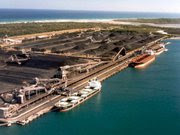
Curb in iron ore exports and hike in duty on outbound shipment have resulted in a number of Centre owned major ports incurring heavy losses of business.
Shipping secretary Mr K Mohandas on the sidelines of a conference told reporters that “All ports have suffered huge losses of business, including New Mangalore, Ennore, Visakhapatnam, Paradip and Mormugao.”
Mr Mohandas said ports are dependent on cargo and iron ore used to contribute significantly in ports’ business.
He also added that mining and exports policies did not come under Shipping Ministry’s purview when asked whether the ministry is taking any step in this regard.
The iron ore exports from the country last fiscal came down to 97.64 million tonne while in the first eight months of the current fiscal, exports dipped by a little over 28% to 40 million tonne vis a vis the corresponding period last fiscal.
Apart from this, upward revision in export duty to 30%, the miners said that will result in total shipments unlikely to exceed 50 million tonne in the current fiscal, which is further bound to impact the ports.
(Sourced from PTI)
Showing posts with label shipping industry. Show all posts
Showing posts with label shipping industry. Show all posts
Thursday, January 19, 2012


Thursday, July 21, 2011
Dry bulk rates edge further down on weak market sentiment
Thursday, July 21, 2011
The dry bulk market fell once again on Wednesday marking the ninth straight day of losses. The industry’s benchmark, the Baltic Dry Index (BDI) was down to 1,328 yesterday, retreating by 0.15%
on the day. Once again it was the bigger ships which suffered. The Capesize segment fell by 0.96% to 1,886 points, while the Panamax market was down by 0.32% to 1,536 points. Among the silver linings of the market was the Handysize/Handymax market with a gain of 0.43% to 695 points.
The first half of the year ended with the average value of the BDI standing at 1,372 points, down by 57 % from the first half of 2010 when the BDI was at 3,166 points and capesizes were earning $11,507/day more than today’s levels. “However, shipping investments have shown a 7% increase from the first quarter of the year with bulk carriers being protagonists in the secondhand market and containers dominating in the newbuilding scene” said Golden Destiny in a relative analysis.
It went on to mention that although bulk carriers have lost their strength in the secondhand and newbuilding market they are still holding the lion share in both markets, 35% of the total volume of transactions. “The lost of confidence is mainly attributable to the weak environment of the dry market as the BDI still hovers below the psychological barrier of 1,000 points mark and Chinese commodities’ demand appears not enough to absorb the ongoing flow of newbuilding deliveries. But, when the demand side will be rebalanced with the supply? The recovery of the market remains pending from the start of the year. During June, the BDI managed to gain a 6% month-on-month rise, but it seems that the high levels of 2010 are not yet feasible. Capesize time charter equivalent earnings have shown a 39.5% growth from May levels, but China’s high iron ore port stockpiles, barriers in electricity consumption and persistent high levels of commodities’ inflation cannot still narrow the gab with the supply side. According to data from the General Administration of Customs, China’s imports of iron ore fell to 51.09 million tones in June, compared with 53.30 million tones in May. The agency said that imports rose 19.3% year-on-year last month, versus the 24.8% rate expected by the economists. The June result was below the 28.4% rate in May and the lowest annual growth rate since the -6.4% posted in October 2009, which was the last of 12 consecutive months year-on-year declines that started in November 2008 after the global financial crisis” said Golden Destiny.
In a separate weekly report from shipbroker Fearnley’s, it was mentioned that the lack of direction in the Capesize market has continued this week, but now showing signs of weakening. “The West Australia market was struggling to decide which side of usd 8.00 the market should be, and fixture have been concluded on both sides, though the most recent reported is at a low usd 7. 75. Also the Front haul market was stable, just over the usd 20.00 mark, but has now dropped below and is not closer to usd 19.50pmt. The Atlantic again was living in its own world, but saw a significant down turn towards the end of the week, but has now stabilized at a healthier usd 13,000 level p/d. This market may not last as we suspect re-let charterers have cleared their tables pending the holiday season, but it should be noted that the tonnage supply is still tight. On the period front some more short period deals have been done in the usd 11,500-12,000 level which is only slightly down from the last rally. One can attribute this to fewer vessels idle (not trading) due to the low market level” said the shipbroker.
Referring to the Panamax market Fearnley’s said “it faced a slow start to the week, with limited activity in all basins. Atlantic rounds have stabilized around mid teens, however the north continent is somewhat tighter on tonnage, so this area might improve somewhat in the next few days. Ballasters for the Pacific are keeping the EC South American market down, in spite of quite a few cargoes out of that area. A few fresh cargoes emerged as well out of Indonesia and Aussie, but not enough to support any rise in rates for the time being. However the fall in rates seems to flatten out. With a tic more positive tone in both basins the last day, the end of the week may bring a steadier market, but this remains to be seen”.
As for the Handy market, “Atlantic softening across all segments with little fresh enquiry ex Bsea/Cont/USG and ECSA. Trips to Feast remain healthy. More cargoes expected for 1st half of August but this remains to be seen. Overall sentiment remains soft in Pacific, however few enquiries keeping market busy. For Indo-India, supras in South China are getting close to 12k. Nickel-ore rounds are getting firm rates in low mid-teens. Very quiet on iron ore front due to monsoons as WCI-China rates slided to 10k and from ECI around 9k. Few cargoes seen from RBCT. As a result, RBCT biz fixed on ECI tonnage around 11k. Red Sea, ferts on handymax/ supras are fixed at very mid 20´s pmt on voy bss to WC India. Period deals done at 13k for large supras” concludedd Fearnley’s.
Nikos Roussanoglou, Hellenic Shipping News Worldwide
The dry bulk market fell once again on Wednesday marking the ninth straight day of losses. The industry’s benchmark, the Baltic Dry Index (BDI) was down to 1,328 yesterday, retreating by 0.15%
on the day. Once again it was the bigger ships which suffered. The Capesize segment fell by 0.96% to 1,886 points, while the Panamax market was down by 0.32% to 1,536 points. Among the silver linings of the market was the Handysize/Handymax market with a gain of 0.43% to 695 points.
The first half of the year ended with the average value of the BDI standing at 1,372 points, down by 57 % from the first half of 2010 when the BDI was at 3,166 points and capesizes were earning $11,507/day more than today’s levels. “However, shipping investments have shown a 7% increase from the first quarter of the year with bulk carriers being protagonists in the secondhand market and containers dominating in the newbuilding scene” said Golden Destiny in a relative analysis.
It went on to mention that although bulk carriers have lost their strength in the secondhand and newbuilding market they are still holding the lion share in both markets, 35% of the total volume of transactions. “The lost of confidence is mainly attributable to the weak environment of the dry market as the BDI still hovers below the psychological barrier of 1,000 points mark and Chinese commodities’ demand appears not enough to absorb the ongoing flow of newbuilding deliveries. But, when the demand side will be rebalanced with the supply? The recovery of the market remains pending from the start of the year. During June, the BDI managed to gain a 6% month-on-month rise, but it seems that the high levels of 2010 are not yet feasible. Capesize time charter equivalent earnings have shown a 39.5% growth from May levels, but China’s high iron ore port stockpiles, barriers in electricity consumption and persistent high levels of commodities’ inflation cannot still narrow the gab with the supply side. According to data from the General Administration of Customs, China’s imports of iron ore fell to 51.09 million tones in June, compared with 53.30 million tones in May. The agency said that imports rose 19.3% year-on-year last month, versus the 24.8% rate expected by the economists. The June result was below the 28.4% rate in May and the lowest annual growth rate since the -6.4% posted in October 2009, which was the last of 12 consecutive months year-on-year declines that started in November 2008 after the global financial crisis” said Golden Destiny.
In a separate weekly report from shipbroker Fearnley’s, it was mentioned that the lack of direction in the Capesize market has continued this week, but now showing signs of weakening. “The West Australia market was struggling to decide which side of usd 8.00 the market should be, and fixture have been concluded on both sides, though the most recent reported is at a low usd 7. 75. Also the Front haul market was stable, just over the usd 20.00 mark, but has now dropped below and is not closer to usd 19.50pmt. The Atlantic again was living in its own world, but saw a significant down turn towards the end of the week, but has now stabilized at a healthier usd 13,000 level p/d. This market may not last as we suspect re-let charterers have cleared their tables pending the holiday season, but it should be noted that the tonnage supply is still tight. On the period front some more short period deals have been done in the usd 11,500-12,000 level which is only slightly down from the last rally. One can attribute this to fewer vessels idle (not trading) due to the low market level” said the shipbroker.
Referring to the Panamax market Fearnley’s said “it faced a slow start to the week, with limited activity in all basins. Atlantic rounds have stabilized around mid teens, however the north continent is somewhat tighter on tonnage, so this area might improve somewhat in the next few days. Ballasters for the Pacific are keeping the EC South American market down, in spite of quite a few cargoes out of that area. A few fresh cargoes emerged as well out of Indonesia and Aussie, but not enough to support any rise in rates for the time being. However the fall in rates seems to flatten out. With a tic more positive tone in both basins the last day, the end of the week may bring a steadier market, but this remains to be seen”.
As for the Handy market, “Atlantic softening across all segments with little fresh enquiry ex Bsea/Cont/USG and ECSA. Trips to Feast remain healthy. More cargoes expected for 1st half of August but this remains to be seen. Overall sentiment remains soft in Pacific, however few enquiries keeping market busy. For Indo-India, supras in South China are getting close to 12k. Nickel-ore rounds are getting firm rates in low mid-teens. Very quiet on iron ore front due to monsoons as WCI-China rates slided to 10k and from ECI around 9k. Few cargoes seen from RBCT. As a result, RBCT biz fixed on ECI tonnage around 11k. Red Sea, ferts on handymax/ supras are fixed at very mid 20´s pmt on voy bss to WC India. Period deals done at 13k for large supras” concludedd Fearnley’s.
Nikos Roussanoglou, Hellenic Shipping News Worldwide
Wednesday, March 16, 2011
Implications of the Japan Crisis on steel, coal, shipping industry
Mar16, 2011
In the aftermath of the devastating earthquake that has hit Japan, fears are growing over the potential for radiation leaks from damaged nuclear plants. Equity markets have been hit while FFA prices have also sustained significant losses. With the situation still unfolding, the longer term impact of the disaster on commodity markets is unclear, although some initial conclusions can be drawn.
In the short term, shipping has been disrupted with 13 ports reported by Reuters to have closed, with some of these unlikely to be operational for several months or even years. Initial assessments by Macquarie and the Steel Index put production at five large steel mills in the worst-affected region at risk, accounting for 15-18 million tonnes (Mt) of annualized steel production capacity. That could potentially remove around 20-25 Mt of iron ore and 9-10 Mt of coking coal demand.
In the longer term, reconstruction should boost demand for steel with potential for significant increases in raw material imports. Whether the additional steel demand is met entirely by Japanese production or partially by China, Korea and/or Taiwan, the overall effect should be a boost to iron ore and coking coal imports into the region. Capesize vessel demand would therefore be the biggest beneficiary, with the Panamax sector boosted by extra coking coal demand alongside additional Handysize and Supramax employment on steel products, timber and grain trades. Should additional cargoes be required into China, this would entail more spot market chartering activity, in contrast to Japan’s traditional reliance on longer term freight contracts.
Meanwhile the nuclear crisis has led to rolling blackouts. Out of Japan’s 54 nuclear reactors, 11 are reported closed. The Fukushima Daiichi nuclear plant has so far suffered explosions at three of its reactors and it will almost certainly be decommissioned once the crisis is over. Japan depends on nuclear power for almost a third of its total energy needs. Recent parallels can be drawn with the closure of the Kashiwazaki-Kariwa nuclear plant for 21 months after the 2007 earthquake in Niigata prefecture and, perhaps more significantly, the temporary shutdown in 2003 of 17 nuclear power stations for emergency safety inspections after it was revealed that inspection reports had been falsified.
The 2003 closures led to an increased reliance on both oil and coal-fired power generation. There was an unexpected spike in Japan’s steam coal imports (including anthracite) in July and August 2003 to more than 15 Mt per month compared to an average of 14 Mt per month during the 1h03. This was a key factor in causing the chronic shortage of dry bulk tonnage at that time that led to the record-breaking surge in freight rates.
The rolling programme of emergency inspections in the months that followed led to a very gradual reopening of nuclear plants, which helped to ensure that Japan’s steam coal demand grew strongly. Combined steam coal and anthracite imports jumped from 112.0 Mt in 2003 to 123.6 Mt in 2004. Improved economic conditions in 2010 resulted in the annual import total rising by 14.1 Mt over 2009 to 131.2 Mt. Beyond the inevitable short-term disruptions, there is potential for further strong rises in steam coal demand. This could be particularly significant in the longer term if the latest tragic developments cause a rethink in Japan of the viability of nuclear generation as a key part of the country’s energy mix. (By Marinelink)
In the short term, shipping has been disrupted with 13 ports reported by Reuters to have closed, with some of these unlikely to be operational for several months or even years. Initial assessments by Macquarie and the Steel Index put production at five large steel mills in the worst-affected region at risk, accounting for 15-18 million tonnes (Mt) of annualized steel production capacity. That could potentially remove around 20-25 Mt of iron ore and 9-10 Mt of coking coal demand.
In the longer term, reconstruction should boost demand for steel with potential for significant increases in raw material imports. Whether the additional steel demand is met entirely by Japanese production or partially by China, Korea and/or Taiwan, the overall effect should be a boost to iron ore and coking coal imports into the region. Capesize vessel demand would therefore be the biggest beneficiary, with the Panamax sector boosted by extra coking coal demand alongside additional Handysize and Supramax employment on steel products, timber and grain trades. Should additional cargoes be required into China, this would entail more spot market chartering activity, in contrast to Japan’s traditional reliance on longer term freight contracts.
Meanwhile the nuclear crisis has led to rolling blackouts. Out of Japan’s 54 nuclear reactors, 11 are reported closed. The Fukushima Daiichi nuclear plant has so far suffered explosions at three of its reactors and it will almost certainly be decommissioned once the crisis is over. Japan depends on nuclear power for almost a third of its total energy needs. Recent parallels can be drawn with the closure of the Kashiwazaki-Kariwa nuclear plant for 21 months after the 2007 earthquake in Niigata prefecture and, perhaps more significantly, the temporary shutdown in 2003 of 17 nuclear power stations for emergency safety inspections after it was revealed that inspection reports had been falsified.
The 2003 closures led to an increased reliance on both oil and coal-fired power generation. There was an unexpected spike in Japan’s steam coal imports (including anthracite) in July and August 2003 to more than 15 Mt per month compared to an average of 14 Mt per month during the 1h03. This was a key factor in causing the chronic shortage of dry bulk tonnage at that time that led to the record-breaking surge in freight rates.
The rolling programme of emergency inspections in the months that followed led to a very gradual reopening of nuclear plants, which helped to ensure that Japan’s steam coal demand grew strongly. Combined steam coal and anthracite imports jumped from 112.0 Mt in 2003 to 123.6 Mt in 2004. Improved economic conditions in 2010 resulted in the annual import total rising by 14.1 Mt over 2009 to 131.2 Mt. Beyond the inevitable short-term disruptions, there is potential for further strong rises in steam coal demand. This could be particularly significant in the longer term if the latest tragic developments cause a rethink in Japan of the viability of nuclear generation as a key part of the country’s energy mix. (By Marinelink)
Subscribe to:
Posts (Atom)

 Posts