Google Website Translator Gadget

Monday, June 13, 2011

POSCO war Zone - Eco clearance no license for forcible land acquisition - Mr Jairam

Monday, 13 Jun 2011

PTI reported that amid protests by locals against land acquisition for POSCO’s steel plant in Orissa’s Govindpur village, Indian environment minister Mr Jairam Ramesh on Sunday asked the state government not to use environmental clearance for the project as a license for forcible acquisition of land.

He said “The POSCO steel cum power cum port project in Odisha was given environment and forest clearance by the ministry of environment and forests after a great deal of thought and a careful balancing of various factors. However, I hope that the state government will not use this clearance as a license for forcible acquisition of land.”

He said the “intent” and “purpose” of the environmental clearance is not to allow forcible acquisition of land.

He said “I have often said that environment and forest clearance process should not be used to fight other battles that have to do with important issues like land acquisition, compensation and livelihoods...I appeal to the Odisha government to ensure that land is acquired only through peaceful and law governed means.”

Mr. Ramesh said while all parties should adhere to democratic norms and procedures, “I earnestly hope that the state government will not take any precipitate action.”

He added that “Dialogue and discussion, not coercion is as essential to ecological security as it is to democracy.” (sourced from Hindu)

Sunday, June 12, 2011

Port Hedland May iron ore shipments jump 15 percent

Jun10, 2011

SYDNEY, June 10 (Reuters) - Iron ore shipments from Australia's Port Hedland, one of the world's largest export terminals, jumped 15 percent to 18.21 million tonnes in May from 15.88 million tonnes in April, data released by the port authority showed on Friday.

Shipments to China, the ports biggest destination, rose to 12.53 million tonnes in May from 11.21 million tonnes a month earlier.

BHP Billiton is the port's biggest user followed by Fortescue Metals Group Ltd . (Reporting by Balazs Koranyi; Editing by Ed Davies, sourced Thomson Reuters)

Euro Coal-Prices dip, Aug ARA trades at $124.25/T

Jun10, 2011 4:15pm GMT

* China buys more discounted Australian
* Coal stays robust despite oil price fall

LONDON, June 10 (Reuters) - Coal prices were 75 cents to $1.50 lower on Friday after a $3 fall in oil and amid a lack of demand for standard-grade coal, particularly in Europe.

Physical coal prices will have to fall by $5-10 a tonne before buyers in Asia or Europe will be drawn back to the market, traders said, but so far the resilience of coal swaps values has prevented physical prices from falling more steeply.

Coal swaps have traded at a premium of a few dollars to physical for several weeks, boosted by strong oil.

Swaps have not reflected the market's fundamental weakness, because they have been influenced more by moves in other markets, but the persistence of prices several dollars above levels at which any buyer is prepared to buy is blocking trade, said utilities, traders and producers.

"Swaps and physical aren't talking to one another. The question is how long can this disconnection continue before something gives?" one utility source said.

UK gas and power prices rose on Friday as low flows from Norway intensified Britain's reliance on liquefied natural gas and high coal prices bolstered gas forward prices.

Stockpiles of coal in Amsterdam-Rotterdam-Antwerp are fairly high, as are stocks at power plants. More cargoes of U.S. and Colombian coal are due to arrive in July, which utilities say they do not need.

In Asia, the outlook for prompt buying of standard-grade physical coal is similarly grim.

China has been buying Australian coal at discounted prices since the tsunami hit Japan earlier this year, and some of this coal has been standard-grade Newcastle described as off-specification material.

Some higher-priced sales of standard-grade, higher energy content Russian and Indonesian cargoes have been made into China recently, but these are a small proportion of the predominantly low-grade, discounted cargoes sold, suppliers said.

India, South Korea and other Asian end-users have also been focussing on the lower-grade, lowest-priced coal origins for months.

Until South African and Newcastle prices drop closer to $100 a tonne, key Asian end-users will avoid this coal whenever possible, suppliers said.

TRADES

Two August delivery DES ARA cargoes traded at $124.25 and $124.75 a tonne, down 75 and 25 cents.

PRICES

A July South African cargo was offered at $119.00, down 75 cents.

An August loading South African cargo was bid at $119.25 and offered at $122.00, up $1.00 on the offer but slightly lower on the bid.

A July DES cargo was both bid and offered at $123.50, down $1.50.
(Reporting by Jackie Cowhig, editing by Jane Baird, sourced Thomson Reuters)

Coal exports through port booming

Asian demand for fuel turns bay into parking lot

By Michael Dresser, The Baltimore Sun
8:44 p.m. EDT, June 11, 2011

Cross the Bay Bridge on any day of the week, and you're likely to see several giant freighters anchored in the water below.

A surge in coal exports from the port of Baltimore has turned the Chesapeake Bay into a maritime parking lot.

Demand from China, India and other countries for high-priced metallurgic coal to fuel steel production has grown so strong that ships are backed up south of the bridge waiting to gain a berth at one of Baltimore's two coal terminals.

To Helen Delich Bentley, the former congresswoman and federal maritime commissioner for whom the port of Baltimore is named, the vessels are reminiscent of the city's shipping heyday in the late 1950s and early 1960s.

"It's kind of like the old days when we had ships waiting in the bay for their turn at the pier," said Bentley, now a maritime industry consultant.

Shipments from the mines of Appalachia have been helping to lead Baltimore's port out of the recession and into some of the healthiest territory it has ever seen. Since the middle of last year, exports of the fuel to the world's fastest-growing region have jumped — in some months doubling the figures from the previous year.

Since October, the port has shipped more than 1 million tons each month, reaching a peak of more than 1.9 million in March — the latest figure available. Last year, the port handled almost 14 million tons of coal exports, more than double its total from 2009 and better than its pre-recession totals.

James White, executive director of the port of Baltimore, said he expects coal exports to set a new record this year.

"It puts the pilots to work, more tugboats, more man-hours at the coal facilities. Yeah, this is fantastic for us," he said.

White said the logjam in the bay hasn't gone unnoticed by the public. During the General Assembly's session this year in Annapolis, he said, "the biggest question I got was, 'Why do we have so many ships in the anchorage?'"

The thriving coal exports have helped bolster Baltimore's status as a leader in the shipment of bulk commodities, which also include such products as gypsum and paper.

The chief beneficiaries of the Asian demand for coal have been the port's two privately owned coal terminals — Consol Energy's CNX Marine Terminal in Southeast Baltimore and the CSX facility on Curtis Bay.

But White said the entire port benefits.

"When public terminals do well, I think it helps the private terminals, and when the private terminals do well, I think it helps us," he said.

While motorists on some roads might catch a glimpse of the black mounds of fuel waiting to be loaded onto ships, the public seldom gets an up-close look at what happens at the port's coal terminals. But they are humming operations, where workers under tight security orchestrate the intricate process of receiving shipments by train, mixing the product of multiple mines to create the desired blend of fuels, and loading the cargo into the holds of the massive ships that haul American coal across the seas.

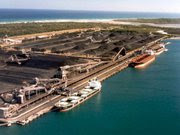
Last Wednesday afternoon, visitors atop the 80-foot-high silo on the CNX property, which commands a panoramic view of Baltimore Harbor, could see the Italian-flagged Giuseppe Mauro Rizzo, a Panamax-class ship capable of carrying about 77,000 tons, tied up at the CNX terminal's berth.

Larger ships of the Cape class, so known because they must round the Cape of Good Hope at the southern tip of Africa to reach Asia, carry loads of about 135,000 tons.

The typical coal vessel has nine to 11 holds, each the size of a basketball court, said Chris Marsh, the CNX vice president who manages the Baltimore terminal. (In the case of Cape-class ships, he said, each hold is as large as a professional arena.)

Marsh said the Giuseppe Mauro Rizzo would be carrying a load from Baltimore to Japan, one of Consol's traditional customers. But he said the recent growth in exports has been driven by China and, to a lesser extent, India.

That surge has brought a new burst of energy to the CNX facility. The company has spent tens of millions of dollars in recent years on improvements to the infrastructure, Marsh said. Employment has gone from 55 to 120 in that time.

"We didn't anticipate how this was going to get as big as fast as it did," Marsh said. The employment created at the terminal might not be white-collar jobs, he said, but they are "high-end, professional, nonoffice" positions.

For CNX, the Baltimore terminal is a way station on the route from its mines in Ohio, Pennsylvania, Virginia, West Virginia and Western Maryland to its major markets in Asia, Europe and Brazil. Norfolk Southern trains creep into the city at night using the Amtrak Northeast Corridor. CSX trains come in from the west through Halethorpe and the Howard Street Tunnel. All arrive at the terminal to the southeast of the Canton waterfront.

Once on CNX grounds, the coal is tipped off the cars and transported on conveyor belts that soar up to 70 feet to be dropped onto piles of up to 135 tons. Once in the piles, the coal is blended to achieve the optimal burning qualities.

Meanwhile, the ships are waiting at anchor for the coal to be ready. Marsh said a vessel can linger at anchorage for as much as two weeks before finally getting the call.

When that happens, the ship is maneuvered by tugboats into the terminal for loading. It typically takes a day and a half to fill a Panamax-class ship with coal.

For years, Marsh said, most of the coal CNX shipped through Baltimore was bound for use in power plants in Europe. But in recent years, the bulk of the business has shifted to metallurgical coal destined for use in the coke ovens of steel plants.

The demand for such coal has been growing as Asian countries — particularly China — have increased their steel-making capacity and their investment in infrastructure.

Whether the recent spike in business is likely to last is difficult to determine. Port chief White said he suspects the torrid pace set in March has receded a little while remaining at high historical levels.

Bentley described the coal trade in the port as a history of booms and busts. Shortly after World War II, she said, Baltimore enjoyed a surge that made it the country's leading coal-shipping port for a time. Since then, it has seen several other booms, including one in the mid-1970s and another in the mid-1990s.

Marsh confirmed the cyclical nature of CNX's coal shipping business in Baltimore, and showed a slide indicating that it hit a low of 2.7 billion tons in 2002 before recovering to 11.3 billion last year. The CNX executive said the outlook is strong.

"We're very optimistic," he said.

Bentley agreed, saying China remains in great need of fuel. She predicts the current boom should be sustainable for at least five years.

But in today's global marketplace, Baltimore's long-term prospects in the coal export trade may hinge on developments in faraway places.

"Everything depends on if China and India keep on growing," said Carlos Fernandez, senior coal analyst at the International Energy Agency, an intergovernmental organization based in Paris.

Fernandez said that while India's growth is steady and predictable, China's is anything but. He said the Chinese are savvy buyers who are constantly shopping the market for the best prices.

Baltimore's position in the Chinese market is strengthened by its high percentage of metallurgical coal exports, Fernandez said. With China's steel industry expanding, he said, its demand for coking fuel — which commands higher prices than thermal coal — is likely to remain strong.

But not too far down the road, Fernandez said, U.S. metallurgical coal could face formidable competitors in Mozambique, South Africa and especially Mongolia, which has huge reserves right in China's backyard. He said it will likely take another four to five years for that country to develop its infrastructure, but when it does, it will enjoy a substantial advantage in transportation costs.

White was cautious about long-term prospects.

"I don't see it as being sustainable as it has been last year and this year, but I wouldn't say it's a bubble," he said. "You're going to see it at highs and then go into some troughs."

For now, White said, Baltimore is running second in coal exports to Norfolk, which has an equally deep channel and better rail connections from many of the coalfields. He said the Virginia port accounts for about 70 percent of East Coast businesses, with Baltimore about 30 percent and other coal terminals — without 50-foot channels — picking up the crumbs.

Not everyone sees the boom as good news. Environmentalists, who would prefer to see the fossil fuel phased out worldwide, are dismayed at the surge in coal use by developing countries.

"If we want to be a leader on combating global warming and supporting clean energy, the last thing we should be doing is expanding our pollution to countries like China and India," said Mark Kresowick, Northeastern regional director for the Sierra Club.

Kresowick said increased coal shipments also raise strictly local concerns.

"They produce an enormous amount of dust and other soot that impacts air quality in Baltimore," he said. "Even a little bit has a lot of negative impacts."

Marsh said CNX goes to great lengths to keep coal dust from getting into the environment. He said the company has reduced the amount of coal that escapes its premises by 85 percent with an aggressive program of spraying the coal piles with water and chemicals that reduce runoff and wind scatter. He said Consol has installed its own facility at CNX that contains any water that has been used to keep the wind from blowing coal dust.

"One of the reasons they sent me here is they know I'm a fanatic about the environment," he said.

Kresowick said the Sierra Club has no plans to seek government policies that would curb exports. But he said the group would draw the line at any attempt to expand Baltimore's coal terminals.

March said that the company has no concrete plans to expand.

"At this point we don't think we need to," he said. Any expansion, he said, "is still pie in the sky."

Bentley said any expansion in Baltimore would be difficult.

"One of our handicaps is that we are short on space," she said.

So for now, drivers on the Bay Bridge can expect to keep seeing huge ships passing the time below them. White, for one, has no problem with that. He said they're out of the main shipping channels, with 80-100 feet of water below them.

"It's safe there for them. They're inland, they're not out at sea," he said. "Actually, I like looking out and seeing the ships out there." (sourced The Baltimore Sun)


Panjiang Refined Coal to invest CNY 500 million in financial products

Sunday, 12 Jun 2011

It is reported that Guizhou Panjiang Refined Coal plans to use a maximum of CNY 500 million of its own funds to purchase low risk short term financial products from banks.

The purpose of the investment is to improve the company's returns from its funds. The products exclude equity and derivative investments. (sourced from cnfol)

Alaska could see another record in coal exports this year

Sunday, 12 Jun 2011

According to Alaska Railroad Corp and Usibelli Mine Inc managers, Alaska could set another record for coal exports in 2011.

Usibelli produces coal from its mine near Healy about 90 miles south of Fairbanks and is considering whether to develop a small coal deposit at Wishbone Hill, near Palmer.

Mr Chris Aadnesen Alaska Railroad President told the Fairbanks Chamber of Commerce June 7 that the state owned railroad expects to carry about 1.2 million tons of coal to Seward for shipment to export markets this year from Usibelli's Healy mine.

Usibelli is cautious however saying that while the company mine in Healy has the mechanical capability of producing to that level and it would put a strain on its people.

Mr Bill Brophy Usibelli marketing manager said "We can do it if the stars align, but we will certainty produce at the same level as 2010. He said that there are many facets to this: in equipment, people and rail capacity, although the coal resources are available.”

He said that a decision on whether to develop the Wishbone Hill deposit is likely to be made late this summer. Wishbone Hill has bituminous coal a higher quality than the sub-bituminous coal mined from Healy. If Wishbone is developed, its coal could be sold directly to buyers or blended with the coal from Healy.

Mr Brophy said the Healy mine produced a total of 2 million tons in 2010, which was a record. About half of that was exported and half shipped to local markets in Interior Alaska. He said that export markets have been growing, but so have coal purchases by the US Army for Fort Wainwright, in Fairbanks.

According to data supplied by the Alaska Railroad to the Fairbanks North Star Borough in 2009, some 801,000 tons were shipped overseas out of the port in Seward, compared to the 471,000 tons exported in 2008. (sourced Alaskajournal)

Soumber Coal deposit officially registers with the Mongolian Government

Sunday, 12 Jun 2011

SouthGobi Resources Ltd announced that it has been notified by the Mineral Resource Authority of Mongolia that Soumber coal Deposit has been officially registered.

The registration process includes calculation of resources to Mongolian standards review of the calculations by MRAM-appointed industry experts and defense of the calculations before the Minerals Resource Committee.

Mineral deposit registration is a prerequisite for applying for a Mining License. Under the Minerals Law of Mongolia, mining licenses are issued by MRAM. The initial term for a mining license is 30 years with an option for two 20 year extensions.

Having completed the resource registration step, SouthGobi intends to formally apply for the Soumber mining license in the coming weeks. The Soumber deposit is approximately 20 kilometres east of SouthGobi flagship Ovoot Tolgoi operation.(sourced from ubpost.mongolnews.mn)

Chinese coke producer plans coal giant in Galilee Basin

Sunday, 12 Jun 2011

It is reported that China biggest private coke producer is planning a multibillion dollar thermal coalmine in Queensland frontier Galilee Basin that would rival the giant mines planned there by Mr Clive Palmer, Ms Gina Rinehart, India Adani and Brazilian giant Vale.

Meijin Energy owned by Chinese billionaire has been quietly drilling coal tenements it acquired in 2007, 230 kilometers southwest of Charters Towers.

Last week, Meijin operating here as Macmines AustAsia outlined its first coal resource at what it is calling the China Stone project. Studies show it has a resource of 3.7 billion tonnes of thermal coal.

A company official said Meijin had plans to add to the resource as it aimed to build a mining operation that would export between 30 million and 60 million tonnes a year of coal from 2014 or 2015. That would dwarf Australia biggest operating black coal mines, BHP Billiton Blackwater and Goonyella which produce about 14 million tonnes of coal a year each.

But it is the typical size of eight thermal coal mines now being planned in the Galilee which remains undeveloped largely because it is further from export ports than Queensland's more-established Surat and Bowen basins.

The planned Galilee Basin operations none of which have been given formal approval have development price tags of USD 3 billion-plus even before taking into account the railways and port expansions that will be needed to handle an extraordinarily ambitious total of 200 million tonnes a year of coal.

To put that in perspective, Australia the world second-biggest coal exporter now exports about 140 million tonnes of thermal coal. (sourced TheAustralian)

BLM denies Wyoming coal lease application

Sunday, 12 Jun 2011

AP reported that he US Bureau of Land Management has denied a coal lease application for possibly the first time in Wyoming because a landowner hasn't given permission for his land to be mined.

Arch Coal subsidiary Thunder Basin Coal Co is seeking to expand its Coal Creek Mine in southern Campbell County in the Powder River Basin. The BLM says talks between company representatives and the landowner have yet to result in permission to mine.

The BLM announced Friday that it has denied an application by Arch subsidiary Ark Land Co. to lease 63 million tons of coal underlying some 1,150 acres as a result.

The BLM oversees federal land and mineral rights in the West. BLM officials in Casper and Cheyenne said they couldn't think of any previous example of the BLM denying a coal lease application in the 20 years companies have applied for permission to mine coal in Wyoming.

They said they weren't privy to the talks between the landowner and company and pointed out that the denial isn't necessarily final if circumstances change.

Ms Teresa Johnson, an environmental protection specialist for the BLM's High Plains District in Casper said "The record of decision is a document that can be appealed if the company or the landowner wishes to do so."

BLM documents say the landowner name is Mr Dennis Edwards. A phone message left for a Dennis Edwards in Wright wasn't immediately returned Friday. St Louis-based Arch Coal declined to comment.

Ms Kim Link company spokeswoman said "We do not comment on matters related to a coal tract that's in an active leasing phase."

The lease was covered in an announcement by Interior Secretary Ken Salazar during a visit to Cheyenne in March. Salazar announced plans to sell of 758 million tons of coal in the Powder River Basin in four auctions this summer. (sourced from AP)

Union hails Pilbara agreement with Rio

Sunday, 12 Jun 2011

It is reported that a major union has announced a breakthrough with mining giant Rio Tinto after striking a deal over a collective agreement for iron ore rail workers in Western Australia's Pilbara region.

The Construction Forestry Mining and Energy Union said it is the first such union agreement with Rio Tinto in the region for 18 years. The union said that after 18 months of negotiation a new collective agreement for around 400 rail workers was reached.

Mr Gary Wood CFMEU mining division WA Secretary who led the negotiations said it was a significant breakthrough and achievement on behalf of the workers and brought fairness back to the workplace.

He said the union had to overcome Work Choices first and then take Rio Tinto to Fair Work Australia to confirm the right to bargain on behalf of workers.

He added that "Rio Tinto workers will now be treated with respect in their workplaces and have won the right to bargain collectively with their employer in regards to their workplace conditions. For the past 18 years, train and car drivers in the Pilbara have been refused this right and have faced corporate hostility when attempting to engage their employer collectively."

When asked if this meant other Rio Tinto workers in the Pilbara might come under union coverage, Mr Wood said the agreement showed that collective arrangements could bring benefits to employees, including a right to be represented on terms and conditions.
He said that "Clearly the legal structures that have been provided for through Fair Work Australia have been followed by both parties in relation to the agreement. We see that the laws are there and the laws are there to be followed and we don't see any change in that going forward."

Mr Wood said the agreement was achieved because of the Fair Work Act and the determination of rank and file members to unite in support of their collective rights.
(sourced Perthnow)

Resource super profit tax - Australia moving closer to legislation

Sunday, 12 Jun 2011

Reuters reported that Australia moved closer to introducing a contentious 30% mining tax being eyed by other countries, releasing draft laws and seeking reaction from resource companies to legislation expected to be passed later this year.

The government unveiled the mining tax over a year ago but modified its plan before last August elections after global miners including BHP Billiton, Rio Tinto and Xstrata launched a public campaign against it.

Big miners and minority lawmakers are now broadly supportive and the legislation is expected to pass parliament and take effect on July 1 2012. Treasury forecasts the tax will reap AUD 7.7 billion in its first two years helping the budget return to surplus by fiscal 2012/13.

Mr Wayne Swan Treasurer said "These reforms will ensure Australians receive a better return from their non-renewable resources and will help strengthen our economy through increased superannuation, new and better infrastructure, and business tax cuts."

Greens lawmakers who will control the balance of power in the upper house Senate from July this year said they would try to harden the tax to reap more from miners, but would not threaten passage of the legislation by insisting on changes.

A Greens party spokeswoman said "It (the draft) will provide a good opportunity to improve the mining tax."

Resource sector fury over the tax and a AUD 20 million campaign against it ahead of last year's cliff-hanger elections led in part to the ousting of former prime minister Kevin Rudd and a minority government for Ms Rudd successor Julia Gillard.

Private consultations with miners over the past few months helped iron out differences over the tax, which applies only to coal and iron ore, but some sticking points remain before the bills go to parliament, after a second drafting round.

The biggest point of difference now involves valuation of multiple tenements within a project, as their classification as a single or multiple projects will influence tax levels and the value of projects that can be shielded from the tax.

The tax point for underground coal mines is also a sticking point as the government is resisting any costly concessions after Western Australia state raised royalties, threatening to cause a AUD 2 billion national budget hole.

Mr Martin Ferguson Resource Minister has promised miners reimbursement for future state royalties, in exchange for acceptance of the tax. But BHP and Anglo Coal are arguing that mine sites straddling multiple exploration or production permits should be treated as a single project, helping them claim tax breaks.

Some big miners have complained the tax would damage Australia sovereign risk reputation, although the government has pointed to a pipeline of planned resource projects totaling AUD 173.5 billion. (sourced from Reuters)


Chinese iron ore imports increase in May

Sunday, 12 Jun 2011

Reuters quoted official data from China customs authority showed that China iron ore imports rose 0.8% to 53.3 million tonnes in May from the previous month.

Chinese steel mills which usually consume two-thirds of seaborne iron ore have raced to expand production since this year, despite Beijing tightening moves to tame inflation and curb the hot property market.

Traders said imports are expected to fall in June as steelmakers have reduced their forward bookings as the domestic steel market usually declines in the summer season.

An iron ore trader in Shanghai said "I expect shipments to fall in June as steel mills have axed their buying and consumed more domestic ore to feed demand."

Chinese steel mills are also expected to be affected by the power rationing mainly from June to September, although the impact to production may not be easily assessed.

(sourced from Reuters)

Nanjing Steel sells marine steel plate to Iran

Sunday, 12 Jun 2011

It is reported that Chinese steelmaker Nanjing Iron and Steel Co has stated that it has lately sold 7,000 tonnes of steel plate for application in marine environments to Iran.

Despite low demand in international markets since late March, steel demand in Iran has been comparatively higher due to oil projects in the country.

In this context, Nanjing Steel has sold the consignment of steel plate in question to Iranian company Pars Oil and Gas Company a subsidiary of state-run National Iranian Oil Company.

(Sourced from SteelOrbis)

POSCO war zone - Congress supports anti POSCO brigade

Sunday, 12 Jun 2011

Asking Orissa Government to refrain from forcible land acquisition for POSCO project near Paradip, Congress committed its support to the people unwilling to give their land for the South Korean steel maker.

Congress sent a four member team headed by party's chief spokesman Prof Kailash Acharya to Dhinkia area where about 600 policemen were deployed to acquire land for POSCO project.

Prof Acharya told PTI over phone that "Though chief minister Mr Naveen Patnaik had announced that force won't be used for acquiring land for industries, today's incident proved his false claim.”

Stating that Congress was totally opposed to the use of force for setting up industries, Prof Acharya alleged that people were not consulted before acquiring their betel vines.

He said that "Land acquisition in Nuagaon gram panchayat is a clear case of state sponsored terrorism. No law is followed for acquiring land for POSCO.”

While the district administration of Jagatsinghpur claimed that it acquired 11 betel vines from Gobindpur village, the Congress team alleged that no beneficiary had turned up to receive compensation.

Prof Acharya said that "This indicated that betel vines are acquired without consent of people and by use of force.” (sourced from PTI)

Villagers protest at POSCO's $12 bln India project

Sat Jun 11, 2011 3:47pm GMT

* Thousands of villagers refuse to back away from site
* Women and children form human ring
* Senior police officer says to 'maintain maximum restraint'
* Fresh protests may further delay POSCO project
By Jatindra Dash

BHUBANESWAR, India, June 11 (Reuters) - About 2,000 villagers protested against POSCO's planned $12 billion steel plant on Saturday, with women and children forming a human ring around the site.

Local opposition has long delayed the South Korean company building its 4 million tonnes plant, India's biggest foreign investment project, in the eastern state of Orissa. Protests have blocked infrastructure projects all across the country.

POSCO signed the agreement for the mill in 2005 and it was scheduled to begin production by the end of 2011. Protests, environmental concerns and government inquiries into alleged illegalities at a related mining concession have delayed it.

Environment Minister Jairam Ramesh gave the plant clearance in January on certain conditions, including ensuring that tribal rights and forest protection laws are observed.

Orissa's government started acquiring land for the world's No. 3 steel company after the environment ministry's January approval. POSCO needs 4,000 acres (1,600 hectares) of land.

Local officials tried to persuade the villagers to back away and not use women and children as human shields, media said.

About 500 policemen were deployed to try to control the protesters, roughly half them women and children.

"We will maintain maximum restraint," a senior police official, who did not wish to be identified, told Reuters.

Locals, who say the POSCO mill will deprive them of their forest-based livelihood, have refused to budge.

"They did not move despite repeated warnings," special land acquisition officer N.C. Swain said.

Swain said the government had already bought 1,800 acres.

"We will not allow them to enter into the site. We will continue our protest peacefully," Prasant Paikray, a protester, said. "We will fight this battle until last breath," he said.

Paikray accused the authorities of acquiring land forcibly.

ArcelorMittal, the world's No. 1 steel maker, has also faced years of delays in building several plants in India. Angry villagers are increasingly assertive in refusing to give up land for manufacturing plant. (Writing by Mayank Bhardwaj; Editing by Louise Ireland, sourced Thomson Reuters)