Google Website Translator Gadget

Showing posts with label shipment. Show all posts

Monday, March 28, 2011

JFE bullish on shipment outlook on strong Asia demand


Mon Mar 28, 2011 1:08pm GMT

* No plans to change H1 shipments forecast - JFE
* Expects H1 sales to top H2 sales of current fiscal year
* Carmakers' output halts could spur Japan steel exports
* METI skips April-June steel demand outlook after quake

(Recasts with JFE comment) TOKYO, March 28 - JFE Steel Corp (5411.T: Quote), the world's No.5 steelmaker, has no plan to change its strong sales outlook after April as robust demand in Asia will likely offset production loss at its domestic customers after the March 11 earthquake.

Japan's biggest ever earthquake, which has left more than 27,000 dead or missing, has caused production halts at a wide range of steel-user companies, including their biggest client Toyota Motor Corp (7203.T: Quote), raising concerns that steelmakers' shipments and earnings will take a hit.

"We still expect our April-September sales will likely exceed sales in the October-March period as Asia's demand remains strong, enough to offset the impact of the disaster," Hiroshi Maki, manager at JFE's sales, planning and coordination division, said on Monday.

JFE has yet to reveal its first-half output plans.

Its October-March production plans call for a 6.4 percent growth in steel shipments at 13.36 million tonnes over a year earlier, counting on higher exports to markets like South Korea, China and Taiwan.

Nippon Steel (5401.T: Quote), JFE and Sumitomo Metal Industries have resumed operations of all seven blast furnaces idled after the quake to cope with rising construction demand and also to increase power supply to the region's struggling electric power companies.

But confusion in distribution channels and shutdowns at carmakers could lead to higher inventories at steelmakers, prompting Nippon Steel and JFE to turn to export markets to make up for sluggish domestic demand.

Lost car production in Japan in the two weeks since the quake has topped a third of a million vehicles, and it could be months, rather than weeks, before the country's automakers get back on track.

Prolonged production delays at domestic steel-users would also make it hard for steelmakers to pass on higher input costs.

"What worries me most is user-companies' output plans," said Takashi Murata, an analyst at Daiwa Securities Capital Markets.

"It will be really tough for steelmakers to pass on higher input costs if their production lines are suspended."

Nippon Steel last month said it was seeking a roughly 25 percent price hike from domestic contract manufacturers after April to cover surging input costs.

Japan's trade ministry said on Monday it would not make its regular estimate on crude steel output for the April-June quarter due to production halts at firms such as carmakers.

An official from the Ministry of Economy, Trade and Industry said it had yet to finish surveying the impact of the quake, but added it may release a quarterly steel production forecast on May 9 as planned.

Tuesday, March 22, 2011

Imperial Metals sees shipment delays post force majeure


Mar 21, 2011
* Says 3 Japanese cos declare force majeure
* Some shipments may be delayed, all 2011 shipments will be made
* Says no impact on this month shipments
* Says Q4 copper production rose 5 pct sequentially
* Sees 11 pct fall in copper production in 2011

March 21 (Reuters) - Imperial Metals Corp said some shipments from its copper mine may be delayed after three Japanese companies declared force majeure on shipments following damages to ports at a smelter after the earthquake in the Asian country.

The Vancouver-based company said the force majeure declared by Mitsubishi , Furukawa and Dowa for the Onahama smelter had no immediate impact on shipments from its Huckleberry mine, which has a life-of-mine contract with the companies.

While it was not clear how disruptive the force majeure would be, the company said according to "best estimates," some shipments could be delayed, but that all planned shipments for the year would be made.

The base and precious metals miner holds a 50 percent interest in Huckleberry Mines Ltd, owner of the mine, which is an open pit copper/molybdenum mine located in British Columbia.

The acceptance of a shipment currently at sea and the shipment scheduled at the end of the month have been confirmed for the Naoshima smelter, the company said in a statement.

The company said its quarterly copper production rose 5 percent sequentially to 15.1 million pounds, but expects a 11 percent fall in copper production to 51.5 million pounds for 2011.

Quarterly gold production fell about 10 percent, while silver production rose nearly 21 percent.

The Vancouver-based Imperial Metals shares closed at C$20.05 on Monday on the Toronto Stock Exchange.

Sunday, February 6, 2011

Brazil Vale buys area in Para for new port -report

Saturday, Feb05 2011
BRASILIA Feb 5 (Reuters) - Brazilian mining giant Vale VALE 5.SA (VALE.N: Quote) has bought a massive area for the construction of a new port in the state of Para, O Estado de S. Paulo newspaper reported on Saturday.

The Porto do Espadarte is still a "strategic opportunity" being studied, said Mauro Neves, planning director at Vale, according to the newspaper.
The project would help reduce the distance between the Carajas mines and shipment, the newspaper said, but faces opposition from environmental groups and others.

Neves added that any construction is unlikely to begin before 2015, according to the newspaper.
(Reporting by Ana Nicolaci da Costa; Editing by Will Dunham sourced:Reuters)

Thursday, January 27, 2011

HRC prices surging in Latin America and Middle East

Thursday, 27 Jan 2011
TEX reported that market prices of HR coils are surging for sales into the world's destinations such as Latin America and the Middle East, a situation where the going prices are believed to have already topped USD 800 per tonne CNF. But there are no signs of negotiated deals so far amid an intense upward mobility in prices.In the case of Latin America, a surge in HR coil prices relates to a surging domestic market for HR coils in the USA. The nation's current HR coil market is reported as a level of USD 780 per tonne, with a high of USD 800 per tonne, caused by a soaring ferrous scrap market there besides a certain level of HR coil demand.

There is information that electric steelmakers such as Nucor Corp and some integrated steelmakers will further increase what they charge for HR coils to a level of USD 870 per tonne for March shipments. The USA's domestic HR coil market stood at a level of USD 620 per tonne in late November last year, but it went up to USD 700 per tonne in early December and to USD 750 per tonne in late December. Also, it has further advanced to a little less than USD 800 per tonne since the beginning of January 2011.US steelmakers are main suppliers of HR coils to Mexico and elsewhere in Latin America. As a matter of course, the USA's soaring HR coil market has repercussions on deals of HR coil supplies to Latin America, where HR coil prices are subject to violent fluctuation because local supply sources are limited in number. A similar situation exists in the Middle East when it comes to HR coil supplies.

Transaction prices of HR coils for the Middle East have yet to hit USD 800 per tonne CNF. But a certain Asian steelmaker is reported to have offered HR coil sales to the Middle East at USD 750 per tonne FOB for March 2011 shipments.Negotiations on new deals of HR coil supplies are under way in Asia as well in what amounts to front loaded ones for shipments in the April-June quarter, given an upswing in quarterly price renewals of raw materials. In this connection, there are signs of the world's spot prices on track to top USD 320 per tonne FOB for coking coal and USD 180 per tonne for iron ore in the April to June quarter, a surge in the raw materials prices that is reminiscent of what happened in the April to June and July to September quarters of 2008, during which time HR coil prices exceeded USD 1,000 per tonne FOB.

The world's various steelmakers are contemplating seeking increased prices of HR coils in what they sell. As a result, it is uncertain how far their offer prices of HR coils will move up, a situation where it is considered difficult both for the steelmakers and their customers to work out a compromise.As far as Japan's integrated steelmakers are concerned, they have shortened the contract period of their HR coil exports to a monthly or quarterly settlement until now, a break with their half-year supply contracts in the past. A half year supply contract would permit a price increase twice a year. But a monthly or quarterly contract would necessitate any pass along to apply all at once for a monthly or quarterly provision.

It is certain that the Japanese steelmakers will seek a three-digit price increase in the renewal of each monthly or quarterly contract. But it remains to be seen whether they will offer a price increase of USD 150 per tonne, USD 200 per tonne, or more.In Asia, meanwhile, market sentiment has yet to follow a surge in HR coil prices. Taiwan's China Steel Corporation is contemplating executing a domestic price increase of HR coils by only TWD 973 per tonne so far for March 2011 shipments. By comparison, moves of South Korea's POSCO are unclear in relation to the company's HR coil prices for domestic sales. Still, it is considered possible for POSCO to win a virtual price increase of HR coils with a reduced discount.

In Vietnam, a price level of USD 700 per tonne C&F is still seen as the norm of what local users require on price for HR coil imports. Under the existing circumstances, however, there is no doubt that transaction price of HR coils will fast advance across Asia over time.
(Sourced from TEX Report Limited)

Coking coal spot prices jump by 14pct last week - Report

Thursday, 27 Jan 2011
Bloomberg reported that Australian coking coal jumped 14% last week as buyers continued to assess the effect on supplies of flooding in the state of Queensland. Queensland, producer of about half of global seaborne supply of coking coal for steelmaking, suffered its worst floods in 50 years this month.

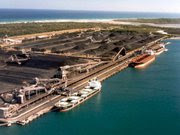
Shipments from the port of Hay Point, the biggest export harbor for the material, dropped 22% last month from November as floodwaters shut mines and damaged rail lines.
Mr Daniel Brebner, an analyst at Deutsche Bank AG in London, said that "The market's still trying to understand what the impact will be in terms of volumes removed. We have seen the worst of the flooding, and that’s behind us and really it comes down to, now, how quickly production can get back on stream."

According to Petersfield, England based market researcher IHS McCloskey, Australian hard prime coking coal sold for USD 320 a tonne on average last week, up from USD 280 the week before. That's the highest level for the data going back to the week ended November 5th 2010.
Mr Brebner said that "Prices may rise over the course of the next month, and USD 350 to USD 400 a tonne is within the realm of possibility."

BHP Billiton Limited, an equal partner in the world's biggest exporter of coking coal, on January 20th 2011 predicted that disruption at its Australian operations until the end of June 2011. Thermal coal from Richards Bay, South Africa, site of the continent's biggest export facility for the fuel, fell 6.1% to an average USD 120.83 a tonne. Thermal coal is burned to generate power. Shipments from the port climbed 3.8% in 2010 to 63.43 million tonnes, the first annual increase in five years.
Benchmark European coal derivatives headed for a third consecutive lower close. Coal for delivery to Amsterdam, Rotterdam or Antwerp with settlement next year fell 35 cents or 0.3% to USD 115 a tonne in London. The data are drawn from information supplied by ICAP Plc, GFI Group Inc, Spectron Group Limited, Tullett Prebon Plc, Credit Suisse Group AG, McCloskey, Bloomberg and Tradition Financial Services.(Sourced from http://www.bloomberg.net/)