Thursday, 05 Jan 2012
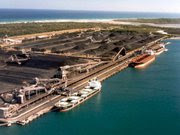
It is reported that the Finance Ministry decision to hike the export duty on iron ore from 20% to 30% within the space of a year spells bad news for iron ore miner Sesa Goa whose profit margins could take a further knock.
Sesa Goa exports medium-grade iron ore from its Goa mines to China. The company hawks low grade ore compared with international players and as such does not command pricing power. Its ability to pass through the higher levy therefore remains doubtful. The 30% export duty would translate to further margin pressures for the company.
The iron ore producer paid INR 660 crore in export duties on INR 8,586 crore of iron ore exports in FY11. During this period, export duties on iron ore fines averaged five per cent. Paying out 30% export duty could cripple Sesa Goa domestic operations which are struggling to raise output. Over the past year, the company has faced setbacks in the form of a ban on exports from its Karnataka mines and closure of Odisha mines.
Both the closures have hit volumes which slipped by nearly 14% to 5.8 million tonnes during the first half of FY12. The new mining Bill may require Sesa Goa to pay a charge equivalent to royalty which currently stands at 10% of the final price.
(sourced TheHinduBusinessline.com)
Showing posts with label Indian iron ore. Show all posts
Showing posts with label Indian iron ore. Show all posts
Thursday, January 5, 2012


Wednesday, January 4, 2012
Iron Ore-China market still slow as traders stay away
Wed Jan 4, 2012
* Prices largely unchanged in first trading day of 2012
* No positive signals to entice buyers back to market
* Impact of Indian export tariff increase seen limited (Updates rebar price)
BEIJING, Jan 4 (Reuters) - Spot iron ore prices in China were mostly unchanged on the first trading day of 2012, with buyers and sellers unable to find a reason to rush back from a two-day new year break.
The offer price of 61.5 percent Pilbara fines, including cost and freight, stood in the $136-139 per tonne range on Wednesday, unchanged from the last trading day of 2011, industry consultancy Umetal said.
Analysts said there was little to entice buyers back into the market, with steel demand low and ore inventories generally sufficient to keep mills running.
"What concerns me a little bit is that Chinese mills seem to have restocked over the last three to four weeks without really pushing the price up at all," said Graeme Train, commodity analyst with Macquarie Securities in Shanghai.
Activity normally slows ahead of China's lunar new year, and many traders have expressed hope that the market will improve when the week-long holiday ends on Jan. 30, but the lull could last longer than that, said Train.
"It seems everyone is waiting for some signal that things are going to get meaningfully better but the government has been very slow to send a very positive signal," he said.
"There is really no catalyst, and we are probably looking at two very quiet months at least."
Analysts played down the impact of India's decision to raise export tariffs in order to guarantee supplies to domestic users, saying the influence of the world's third-biggest iron ore producer had already been on the wane.
India announced this week that it would increase iron ore export tariffs from 20 percent to 30 percent in an effort to guarantee supplies for domestic users.
"I can't see demand strong enough in 2012 to make global supply and demand tight enough to bring Indian marginal producers back into the market, so I can't see it supporting higher prices," said Sebastian Lewis, head of data and analytics with Steel Business Briefing in Shanghai.
"More likely it will accelerate the trend in declining Indian exports and Australia and other miners will be the beneficiaries," he said.
Umetal said Indian 63.5/63 percent iron ore was being offered at $143-146 per tonne on Wednesday, also unchanged.
It added in a research note that the decline in Indian iron ore export volumes had already been offset by growing shipments from South Africa, Iran, Canada and Russia.
While India remains China's third-biggest supplier after Australia and Brazil, its market share has been in decline. In the first 11 months of 2011, India's total shipments of 63.3 million tonnes represented 11 percent of the total, down from 15.6 percent in 2010.
Deliveries from South Africa, Iran, Canada and Russia reached nearly 73 million tonnes over the 11 months, up 33 percent compared with the same period of the previous year.
The most traded steel rebar contract on the Shanghai Futures Exchange ended Wednesday at 4,159 yuan ($660) per tonne, down 51 yuan per tonne or 1.21 percent from the previous session. ($1 = 6.294 yuan)
(sourced Reuters)
Indian iron ore export tax hike reactions from miners
Wednesday, 04 Jan 2012
It is reported that the country miners have said the upward revision in iron ore export duty to 30% will make India produce uncompetitive in the global market and total shipments are unlikely to exceed 50 million tonnes in the current fiscal.
Mr RK Sharma Federation of Indian Mineral Industries' Secretary General said "The government has further hiked export duty on iron ore to 30 per cent on December 30. This will make Indian iron ore totally uncompetitive in the world market."
He said that "Iron ore exports are already down by around 30 per cent during the April-November period of the current fiscal over the same period last fiscal. It will be far more challenging next year."
Mr Sharma said in the remaining period of the current fiscal, only some quantity of exports would be feasible from Goa, besides stocks lying at other ports. He said that "However taking all, it is not going to be 45 million tonnes to 50 million tonnes in the current fiscal."
Mr Glen Kalavampara secretary of the Goa Mineral Ore Exporters' Association said "We are shocked at the decision to hike export tax on iron ore as such volatility in policy does not promote India's image as a reliable supplier."
He said that "Absence of supplies from India will help Australian and Brazilian suppliers to consolidate their domination of the global market."
India, the world third largest iron ore exporter, had shipped 117.3 million tonnes of iron ore in 2009-10 and 70% to 80% of this was in the form of fines which do not have many takers among domestic steel makers. In 2010-11, iron ore exports from the country came down to 97.64 million tonnes and in the first eight months of the current fiscal, exports dipped by a little over 28% to 40 million tonnes vis-a-vis the corresponding period last fiscal.
(sourced Reuters & ET)
Friday, December 30, 2011
China imported iron ore stocks down in wk ending Dec 30
Fri Dec 30, 2011
BEIJING, Dec 30 (Reuters) - Stockpiles of imported iron ore at major Chinese ports fell this week to 95.6 million
tonnes, according to industry consultancy Mysteel
   Following is a table showing iron ore port stock movements
in the last seven days.
Country of  Stockpiles  Change (%)
origin      (mln T)
Total       95.60        -1.26%
Australia   41.70        -1.58%
Brazil      23.83        +0.8%
India        9.64        -4.27%
Sourced: Mysteel & Reuters
Monday, December 19, 2011
Exports may be canalized - Report
Monday, 19 Dec 2011
Business Standard reported that to monitor iron ore exports, a cause of illegal mining, the Indian government plans to canalise exports of the mineral.
The report quoted a senior official as saying that “The proposal will be sent to the Union Cabinet once inter ministerial discussions are completed. The ministry of mines is in discussion with the ministry of commerce and industry.”
He told BS “The basic idea is to have a single agency accountable for the illegalities that arise in the iron ore trade.”
The official said “The setting up of a canalising agency would act as a short-term solution until we put in place mechanisms to improve poor last-mile governance in mineral-rich states, the basic reason for illegal mining.”
The report added that the government is considering the recommendation on a ban on exports in the context of the export import policy.
Currently, iron ore exporting companies enter independent bilateral deals with foreign entities. If the canalising proposal comes through, big exporters such as Sesa Goa, Fomento Resources, MSPL Ltd and VM Salgaokar & Bro would be forced to execute these contracts through a government owned company such as MMTC, NMDC or State Trading Corporation.
(Sourced from BS)
Friday, December 16, 2011
NMDC not to buy stake in Greystone iron ore mine in Brazil
Fri, December16, 2011
The Indian Express reported that India’s state run mineral giant National Mineral Development Corp is all set to drop its proposal to pick up 50% equity of Greystone Iron ore Limited’s mine in Brazil, as the firm’s holding company Zamin Resources is listed in the British Virgin Islands, a known tax haven.NMDC was planning to pick 50% equity in Greystone for USD 40 million to take the project to Bankable Feasibility Study stage and initiate exploration, drilling and allied activities after the equity transfer.
As per report, NMDC is exercising caution, given that the government is under pressure to unearth black money stashed in tax havens by both individuals and companies.The move comes barely a month after the company shelved a proposal to acquire the Vinci coal project in Russia as one its owners were listed in North Korea.
(sourced:Indianexpress.com)
India's iron ore exports plunge in Jan-Nov period
Fri, December16, 2011
Iron ore exports from the country have plunged sharply so far this year.In the first 11 months of 2011, export volumes totalled an estimated 80 million tonnes. This represents a year-on-year fall of as much as 22 million tonnes.
First it was Karnataka from where iron ore exports were prohibited; but subsequently the ban was lifted. It is now Orissa's turn. In November, preliminary export data suggest shipment of 5.1 million tonnes, down more than a third year on year. A major reason for decline in export volume is said to be Orissa. The State Government has stopped issuing iron ore export permits for cargoes shipped via two ports in Andhra Pradesh, namely Gangavaram and Kakinada.
Non-submission data is said to be the reason for the embargo.
Orissa ban
While Paradip port accounted for about 14 million tonnes shipment so far this year, the two ports in Andhra Pradesh handled 4 million tonnes. The Orissa Government has already enforced a ban on transport by trucks and has reportedly not been issuing export permits for the past 2-3 weeks, according to industry insiders.
The State Government is under pressure in the wake of investigation following allegations of illegal mining in Orissa. India's peak export of iron ore was during fiscal 2009-10 with estimated shipments aggregating 117 million tonnes which declined to 97 million tonnes in fiscal 2010-11.
Interestingly, it was only earlier this month, the OECD Steel Committee (of which India is a part) talked about rising concerns over availability of raw material (notably, iron ore) supply to meet the global demand of the steel industry. A related workshop emphasised the growing role of China and India, in addition to other emerging economies, in global demand for raw materials such as iron ore.
Export curbs
On the policy side, the workshop noted that export curbs applied to minerals and metal products have become more frequent, causing concern in countries that rely on imports of raw materials for steelmaking. At the same time, it is absolutely essential that finite raw material sources like iron ore are conserved in the country for future requirement.But the real issue at hand is not domestic availability for the future, but suspicion of ongoing illegal mining for the lucrative export market.
(sourced Business Line)
Tuesday, December 13, 2011
Indian government update on export of iron ore
Tuesday, 13 Dec 2011
The Indian minister of steel Mr Beni Prasad Verma said that during the year 2010-11, 97.66 million tonnes of iron ore was exported out of the total estimated production of 208.11 million tonnes of iron ore in the country.
In a written reply in the Lok Sabha he said that out of the total export, only about 2.93 million tonnes (about 3%) of iron ore was of high quality (with Fe content 64% and above). The total domestic consumption of iron ore (including both private sector and public sector steel plants) during 2010-11 was estimated as 111.4 million tonnes.
The production of iron ore in the country is about double the consumption of iron ore by the domestic iron & steel industry and therefore, is sufficient to meet the present requirement of domestic iron and steel industry.
Mr Verma said that ministry of steel is of the view that iron ore, being a non renewable natural resource, should be conserved for long term utilization of domestic steel industry. The government has decided that conservation of iron ore resources of the country should be achieved not by banning or capping the export of iron ore but by taking recourse to appropriate fiscal measures.
Presently, an export duty of 20% ad valorem is levied on all grades and varieties of iron ore (except pellets).
Wednesday, November 23, 2011
NSL Consolidated to earn cash flows from iron ore production in India
Wednesday, 23 Nov 2011
NSL Consolidated is set to commence cash flow generation in H1 2012 from its Indian iron ore operations, as well as aggressively explore its Queensland coal tenements.
To date, NSL is the only foreign company that has been granted the right to own and operate iron ore mines in India, which is the world’s third largest iron ore exporter in parallel with having a strong domestic steel market.
NSL is aiming to become a dual bulk commodity company, with Indian iron ore production and Australian coal. It is closing in on the first goal.
This is a re born NSL with a new bulk commodity focus in two countries, with cash flows from a planned nine months to iron ore production strategy in India in 2012. It has high leverage to near term iron ore prices not a 2014 production story. It also has exploration upside and blue sky from its large tonnage coal tenements in Queensland.
The company is also developing a grass roots coal exploration project in South Western Queensland. The highly prospective tenements are located in the Eromanga Basin, and are close to significant thermal coal resources and infrastructure including power, water, sealed roads and a rail link to coastal export facilities.
(sourced proactiveinvestors)
Friday, November 18, 2011
CBI probes Rs 780-cr iron ore transportation scam
Fri, Nov.18, 2011
An initial investigation conducted by the Railways revealed that the company caused huge revenue loss to it by making false or misleading declaration about the end use of the iron ore lifted from mining sources.
New Delhi, Nov. 16:
CBI is investigating a scam worth at least Rs 780 crore by a mining firm which allegedly defrauded the Railways in transportation of iron ore meant for commercial activities by making false declaration about its end use.
Official sources said the alleged irregularities were carried out in connivance with certain senior officials of South Eastern Railway (SER) for wrongfully transporting the goods from its Chakradharpur division which were exported through Haldia Port in West Bengal.
An initial investigation conducted by the Railways revealed that the company caused huge revenue loss to it by making false or misleading declaration about the end use of the iron ore lifted from mining sources.
It detected that certain industrial units were transporting iron ore through the Chakradharpur Division of SER declaring the material was for domestic consumption or internal use. “Actually the iron ore was being exported through Haldia Port. The investigations initially revealed a loss of revenue of about Rs 50 crore for a period of nine months in the year 2010 by a private company,” a source said without divulging the name of the company.
Later, the scope of investigations was widened to cover three years from 2008-09 to 2010-11.
“The recoverable amount worked out by the Railways in mis-declaration of goods is Rs 749.50 crore,” he said.
Officials have got evidence of similar modus operandi being opted by other companies active in mining activities in Jharkhand and Orissa and they are now being separately investigated.
The case was referred to the CBI for an in-depth probe by the Central Vigilance Commission.
“The scam is huge and there is a possibility of involvement of certain railway officials who colluded with certain mining firm owners,” the official said.
Keywords: CBI probe, iron ore transportation scam, irregularities, South Eastern Railway,
Sourced:BusinessLine
An initial investigation conducted by the Railways revealed that the company caused huge revenue loss to it by making false or misleading declaration about the end use of the iron ore lifted from mining sources.
New Delhi, Nov. 16:
CBI is investigating a scam worth at least Rs 780 crore by a mining firm which allegedly defrauded the Railways in transportation of iron ore meant for commercial activities by making false declaration about its end use.
Official sources said the alleged irregularities were carried out in connivance with certain senior officials of South Eastern Railway (SER) for wrongfully transporting the goods from its Chakradharpur division which were exported through Haldia Port in West Bengal.
An initial investigation conducted by the Railways revealed that the company caused huge revenue loss to it by making false or misleading declaration about the end use of the iron ore lifted from mining sources.
It detected that certain industrial units were transporting iron ore through the Chakradharpur Division of SER declaring the material was for domestic consumption or internal use. “Actually the iron ore was being exported through Haldia Port. The investigations initially revealed a loss of revenue of about Rs 50 crore for a period of nine months in the year 2010 by a private company,” a source said without divulging the name of the company.
Later, the scope of investigations was widened to cover three years from 2008-09 to 2010-11.
“The recoverable amount worked out by the Railways in mis-declaration of goods is Rs 749.50 crore,” he said.
Officials have got evidence of similar modus operandi being opted by other companies active in mining activities in Jharkhand and Orissa and they are now being separately investigated.
The case was referred to the CBI for an in-depth probe by the Central Vigilance Commission.
“The scam is huge and there is a possibility of involvement of certain railway officials who colluded with certain mining firm owners,” the official said.
Keywords: CBI probe, iron ore transportation scam, irregularities, South Eastern Railway,
Sourced:BusinessLine
Wednesday, November 16, 2011
Indian forging industry demand for transparency in iron ore exports
Wednesday, 16 Nov 2011
According to Mr Baba Kalyani former president of Indian forging association and CMD of India’s largest manufacturer and exporter of automotive components Bharat Forge Limited, the Association of Indian Forging Industry is demanding transparency in iron ore distribution procedures to create more value addition.
Mr Kalyani on the sidelines of the 20th International Forging Congress said that “We find pleasure in exporting our precious iron ore to China rather than converting it into steel. This is where you need a policy perspective where we need transparency.”
Mr Kalyani said “India has a policy that encouraged exports of iron and discouraged steel making. For instance, China has imposed a 40%t export duty on cooking coal because they do not want cooking coal to be exported out of the country.”
Replying to query, he said he was not demanding any policy on steel pricing, but was in favour of creation of a policy for national interest.
Mr Deven Joshi president of AIFI said that the total production of forgings in the country, which was 1.8 million tonne in 2009-2010, increased to 2.3 million tonne during the year ended March 2011 and is expected to touch 4 million tonne by 2014.
The Indian forging industry is expected to grow exponentially as the automobile industry is set to triple the output to 10 million vehicles a year in the next 8 to 10 years. The INR 15,000-crore Indian forging industry is set to witness a year on year growth of over 20% besides attracting investments to the tune of USD 3 million by 2015 for capacity expansion.
(Sourced from BS)
Sunday, November 13, 2011
Iron Ore E-Auctioning: Another Worry to Indian Steel Producers
November13, 2011
By Rahul Jalan
Rahul Jalan, a Chennai-based senior research analyst in metals for Beroe, Inc. who tracks the global steel and rare earths supply chain and analyzes global procurement developments to help develop procurement solutions for the company. Beroe specializes in providing procurement intelligence for a broad swath of industries, enabling buyers’ decision-making.
India’s Supreme Court also recently allowed the e-auction of 1.5 million tons of ore every month to 400,000 tons every Wednesday (from the already-mined 25 million tons) to the steel mills within Karnataka. Of the 25 million tons, around 15 million tons may be in the category of higher-grade with 60%+ Fe content and the remaining 10 million tons of lower-grade, which cannot be consumed by the domestic steel industry.
These iron ore auctions don’t seem to be helping the domestic steel industry, as the buyers are not happy with the fixation of the iron ore base price and the exploitation of buyers who desperately need ore. The base price is fixed based on the prevailing prices in China and Japan, excluding export duty and transportation costs to ports.
The base price at the first e-auction process for high-grade iron ore (63% Fe content) was set at INR 3,700 (US $82) per ton (as against the market price of INR 3,500 (US $72) per ton) and it fetched up to INR 5,800 per ton at the auction — an appreciation of about 50 percent. The base price for iron ore fines at the e-auction was set at INR 2,700 (US $56) per ton. The difference in the prices of high-grade iron ore to low-grade was at INR 1,470 (US $30) for a difference of 6 percent for every percent fall in Fe. However, the recently concluded e-auction process provided a discount of only INR 162 (US $3.37) for a 6.1 percent fall in Fe.
Moreover, the auctioned iron ore price is not inclusive of royalty and taxes. The steelmakers have to pay an additional cost of 10 percent royalty and 12 percent forest development tax (FDT) to the state government on the final auctioned price. The final landed cost of the auctioned iron ore has severely increased the raw material price.
(sourced Metal Miner)
Thursday, November 3, 2011
Notification delay may pull NMDC iron ore exports below 1 mn tonnes
Thu, 3 Nov, 2011
Hyderabad : State-owned NMDC’s exports of iron ore may fall by over 61 per cent to less than 1 million tonnes this year from 2.6 million tonnes last year, a senior official of NMDC has said.
The official, who declined to be named, said the drop in exports will not impact the financials of the company, as domestic demand and prices are encouraging.
The plunge in exports is primarily due to the delay in issuance of a notification by the government permitting overseas shipment of the mineral resource even after Cabinet approval, the official said.
“Even if we get approval from the government this month or next month, we will consider exports on a pro rata basis.
If we start exports in January, we may export around 0.6 or 0.7 million tonnes this year. We may not touch the 1 million tonnes mark,” the official told PTI.
When contacted, NMDC Chairman and Managing Director Mr Rana Som said Cabinet has approved exports by the company to the extent of 2.8 million tonnes per year for three years.
He also confirmed that the export entitlement of the company in each year will be determined on a pro rata basis.
NMDC sells fine variety ore at Rs 3,380 per tonne and lumps at Rs 4,600 per tonne.
Total exports of iron ore amounted to 2.56 million tonnes during FY’11, as against 3.43 million tonnes in the previous financial year, a decrease of 25 per cent.
Meanwhile, a team of officials from Minemakers Limited, an Australia-based mining company, is meeting with NMDC officials on a proposed joint venture to develop the Wonarah phosphate deposit in Australia’s Northern Territory.
“They are in Hyderabad. We will have to study what all reports they gave us on the project. After that, we will conduct due diligence and take a decision,” Mr Som said.
NMDC had earlier entered into a non-binding agreement with Minemakers to develop the latter’s Wonarah phosphate deposit, which is Australia’s largest undeveloped rock phosphate project.
If the project is found favourable, NMDC and Minemakers will then form a JV in which the Indian miner will pick up a 50 per cent stake and have the responsibility for arranging finance for the project through debt raising.
NMDC will also repay Minemakers for costs already incurred on the development of Wonarah.
The investment made by NMDC on the study and other activities may be converted into capital when the JV is formed.
Keywords: notification delay, NMDC, iron ore exports
(sourced The Hindu Business Line)
Wednesday, November 2, 2011
Haldia and Visakhapatnam ports sharing info on ore exports
Wednesday, 02 Nov 2011
BS reported that coming under intense pressure from the Orissa government, the port authorities of Haldia and Visakhapatnam have started to share complete information on mineral ore exported from their ports from November 1st 2011.
These ports had furnished information to the state once in a fortnight beginning November 1st 2011 on the number of trucks arriving at the ports, the quantity of mineral loaded, the quantum of ore exported and names of transporters.
Mr BK Patnaik chief secretary of Orissa said that "Except the Paradip Port, none of the other ports were sharing information on ore exports. We had asked the authorities of different ports to come for on Tuesday's meeting. The authorities of Haldia and Visakhapatnam have agreed to share information on ore exports once in every 15 days from November 1st 2011. The state government, in turn, will verify whether the ore transporters are having a valid permit or not as we have got some allegations of minerals being illegally transported from the state. The authorities of Gangavaram and Kakinada ports did not attend the meeting."
Mr GJ Rao chairman of Paradip Port Trust said that "We are already providing information to the Orissa government on ore exports and will continue to do so in the future."
Peeved over the irregularity in submission of information on ore exports by some of the ports, the Orissa government had recently sought the intervention of the Centre to ensure that the details of ores received at different ports are supplied to the state director of mines.
Mr Patnaik had shot off a letter to the union cabinet secretary Mr Ajit Kumar Seth on October 21st 2011 in this connection.
Mr Patnaik said in his letter to the cabinet secretary that "It is seen that almost all the ports excepting Paradip Port located in the state, are not furnishing the information regularly on the receipt of minerals through road and rail for export purpose to enable the state government to verify whether the minerals have been received against valid permit. The ministry of shipping may be advised to ensure that the details of ore received at different ports are supplied to the Director of Mines, Orissa to co relate with the quantity for which royalty payment has been made by the lessees."
(sourced from Business-standard)
Saturday, October 29, 2011
Iron Ore-Spot price on course for worst week ever
Sat, 29 October 2011
Spot iron ore prices are headed for their worst week ever as miners continued to ship cargoes even as demand from top consumer China remained slack.
But stabilising prices of forward swaps and growing inquiries from Chinese steel mills suggest the freefall in iron ore -- which has lost 34 percent of its value since early September -- may soon hit a bottom.
Iron ore with 62 percent iron content fell more than 6 percent to $120 a tonne on Thursday, according to Platts IODBZ00-PLT, its lowest since July 2010.
The steelmaking ingredient has dropped 16.7 percent so far this week, its steepest decline on record.
Top iron ore producer Vale is waiting to sell around 10-15 capesize cargoes, with each shipment at around 150,000 tonnes, while second-ranked Rio Tinto needs to liquidate around 15 million tonnes of Australian material, said a Singapore-based trader.
Vale, Rio and BHP Billiton , which together control more than two thirds of the global seaborne iron ore market, continue to produce at full capacity despite the slump in iron ore prices because they are betting on China's long-term demand remaining strong.
"All these are putting pressure on the market so the slide will continue for at least three more days including today. But if the paper market continues to go up it will give confidence to the mills and they'll start buying, maybe later part of next week," he said.
"But if the iron ore prices goes up, it won't be so fast because a lot of new tonnage will come into the market," he added.
Prices of forward swaps cleared by the Singapore Exchange <0#SGXIOS:> rose on Thursday after recent heavy losses, with the November and December contracts gaining $2 each to $118.83 and $118.17 a tonne, respectively.
The volume of SGX swaps hit a record 1,736 lots, or 868,000 tonnes, on Thursday. Open interest also reached an all-time high of 10,487 lots, or 5.2 million tonnes, according to the SGX website.
Rising inquiries from Chinese mills and more stable steel prices also spurred hopes iron ore prices could rebound soon.
"More mills have started inquiring so the market may find a bottom soon. They are showing interest and talking numbers while before they have simply dismissed offers," said a purchasing manager for an iron ore trading firm in Shanghai.
Shanghai steel futures rose 2 percent to close at 4,123 yuan a tonne on Friday, gaining 4.2 percent for the week, its first gain in seven weeks. The recent falls in steel prices saw Chinese mills curbing output with average daily crude steel production dropping to 1.7998 million tonnes over the Oct. 11-20 period, the first time it has fallen below 1.9 million tonnes since February, data from the China Iron & Steel Association (CISA) showed on Thursday.
source: Reuters
Friday, October 21, 2011
China imported iron ore stocks up in wk ended Oct 21
Fri Oct 21, 2011
SHANGHAI, Oct 21 (Reuters) - Stockpiles of imported iron ore at major Chinese ports rose marginally this week to 92.22
million tonnes by Friday, after declining for five consecutive weeks in a row.

Shipments from Australia fell over the week, while those from Brazil and India rose slightly.
Following is a table showing iron ore port stock movements in the last seven days.

Country of  Stockpiles  Change (%)
origin      (mln T)
Total       92.22       +0.05
Australia   39.95       -0.17
Brazil      21.98       +0.23
India       11.40       +0.80

Source: Mysteel
Thursday, September 15, 2011
E auction of iron ore begins
Thursday, 15 Sep 2011
BS reported that the E auction of iron ore as directed by the Supreme Court commenced and on the first day of auctions witnessed the total sale of 400,000 tonnes at around 25% more than the base price.
The auctions were held through the e-auction portal www.mstcecommerce.com.
As many as 60 buyers from the steel and sponge iron manufacturing companies in Karnataka participated in the E auction and bought about 100 lots of 4,000 tonnes each of iron ore.
The auction is understood to have fetched around INR 180 crore.
According to industry sources the public sector MSTC, which was appointed by the Supreme Court to conduct the auction had fixed a base price of INR 2,700 per tonne for iron ore fines and INR 3,700 per tonne for iron ore lumps with 63% and above grade.
(Sourced from BS)
Tuesday, September 6, 2011
Chinese imported iron ore stocks hit record in week to Sept 2
Tuesday, 06 Sep 2011
In million tonnes
(Sourced from Reuters)
Reuters quoted according to data from industry consultancy Mysteel said that inventories of imported iron ore at major Chinese ports rose 0.5% to a record 95.59 million tonnes by the end of this week.
Inventories originating in Brazil fell slightly but that was offset by increases in deliveries from India and Australia.
Following is a table showing iron ore port stock movements in the last seven days.
| Country of Origin | Stockpiles | Change |
| Total | 95.59 | 0.5 |
| Australia | 38.12 | 0.6 |
| Brazil | 22.97 | -0.6 |
| India | 14.17 | 3.7 |
In million tonnes
(Sourced from Reuters)
Saturday, August 13, 2011
China port iron ore stocks fall in week ending Aug 12
Aug12, 2011
Beijing (Reuters) - Stockpiles of imported iron ore at major Chinese ports slipped 0.6 percent this week to end at 94.74 million tonnes, according to data from industry consultancy Mysteel on Friday. Volumes from Brazil increased over the week, but were offset by a fall in deliveries from Australia and India.
Beijing (Reuters) - Stockpiles of imported iron ore at major Chinese ports slipped 0.6 percent this week to end at 94.74 million tonnes, according to data from industry consultancy Mysteel on Friday. Volumes from Brazil increased over the week, but were offset by a fall in deliveries from Australia and India.
    Following is a table showing iron ore port stock movements

in the last seven days.

Country of origin   Stockpiles  Change

                   (mln T)     (%)

Total               94.74       -2.6

Australia           38.01       -0.7

Brazil              23.21       +3.9

India               13.60       -1.2


Source: Mysteel
Tuesday, July 5, 2011
Indian iron ore mining mess - Mr Hegde dismisses allegations about delay in second report
Tuesday, 05 Jul 2011
Dismissing allegations that there was deliberate delay, Karnataka Lokayukta Justice N Santosh Hegde on Sunday said his team is working toward finalizing the second and final report on illegal mining in the State to be released this month.
Speaking to PTI, Mr Hegde rejected allegations by some opposition Congress leaders of deliberate delay in finalizing the report.
He said that “I have got a team of four people working on it. There are thousands and thousands of pages involved in it. Therefore, there has been some delay, and certain political parties are attributing motives and I don’t care a damn about anybody.”
Mr Hegde a member of the joint committee drafting the Lokpal bill explained that unlike the first report submitted by him to the Government in December 2008, this time a lot of information needed to be collated.
He noted that in recent months, CBI and Central Empowered Committee also made enquiries (on the illegal mining in Karnataka) and there were a series of Income Tax department raids in March.
Mr Hegde a former Supreme Court judge referring to some delay in compiling the report said that “They (CBI, CEC and IT department) agreed to give us some inputs; we agreed to give them some inputs.”
Mr Hegde said that “People should understand that there are (Lokayukta) people who are working on Sundays...day and night (to complete the report). Main reason is we can’t have more people (working on it) because then other issues will come up such as ‘oh! report is leaked’ and all that.”
He said the report would be submitted to the Government this month itself.
(Sourced from The Hindu)
Subscribe to:
Posts (Atom)

 Posts