March 14, 2011
By Barry FitzGerald
Oversupply will see the price of the product, and the stock of the companies that mine it, decline.
IT WAS not that long ago that iron ore prices were knocking on the door of $US200 a tonne. For the good stuff anyway. But the same sort of uncertainty and risk aversion that knocked the stuffing out of base metal prices in recent weeks is also at play in the iron ore market. Prices have come back to $US170 a tonne.
Unlike most of the base metals where prices are expected to recover - and the haven status afforded to gold and silver - there is a deep longer-term concern with iron ore as the market is racing towards oversupply.
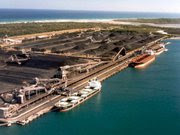
Encouraged by the bumper prices - it costs Rio Tinto and BHP Billiton no more than $US40 a tonne to produce iron ore in the Pilbara - there is an almighty expansion in global iron ore capacity under way.
The world's biggest exporters of the stuff (Rio, BHP and Vale) are leading the way, knowing that when the inevitable price crunch in response to over supply does come, they will still be at the bottom of the global cost curve.
The big question is when will the crunch come? It is not that far off, raising fears for the dozens of Aussie iron ore hopefuls that are yet to get into production or which don't yet have a solution to their rail and port infrastructure shortcomings.
Goldman Sachs reckons that the iron ore market will move into over supply in 2014 and that ''prices will fall significantly at that time''.
It is forecasting modest oversupply in the traded (seaborne) market in 2013 of 48 million tonnes or 4 per cent, growing to a surplus of 147 million tonnes or 12 per cent in 2014 and some 266 million tonnes or a 20 per cent surplus in 2015.
To put that in perspective, BHP is currently producing at an annual rate of 148 million tonnes from its Pilbara operations. So come as early as 2014, an equivalent amount of iron ore - be it from the Pilbara or anywhere else - will be surplus to world demand.
There are no prizes for guessing that prices will come tumbling down at that point. Goldman Sachs estimates a price in 2013 of $US115 a tonne, falling to $US85 a tonne in 2014 and $US80 a tonne in 2015. It didn't say so, but the $US80 a tonne level is also roughly the price at which iron ore production in China and India becomes uneconomic. So even at the lower levels, Australia's greatly expanded iron ore production will find a home. It's just that the current magical profitability of the sector is not going to last.
The lesson in all this is that investors in iron ore stocks need to plan ahead. The market can be expected to take to the share prices of iron ore stocks at least 12 months before the supply crunch hits.
On current thinking, that means that the music for the iron ore stocks will stop late 2012, early 2013.
IT MIGHT be 2011 but Australia still boasts an under-explored minerals frontier, one that just might be home to world-class nickel, copper, gold and platinum deposits that have remained hidden under sand cover.
It is the Musgrave province that straddles the common borders of South Australia, Western Australia and the Northern Territory.
A taste of the province's mineral potential came in 2000 when WMC Resources, now part of BHP Billiton, discovered the Nebo/Babel deposit in the WA portion of the province.
Not much has happened since. The province is seriously remote and access agreements with traditional owners can be a slow process. The hidden mineral wealth is also covered by a 100-metre, on average, blanket of sand.
But in one of the most unusual floats ever seen on the local market, a bunch of mining companies and explorers have decided the Musgrave province - at least the SA portion - might best be explored on a co-operative basis.
They are combining their exploration interests in the province and raising $15 million for future exploration through Musgrave Minerals Ltd.
The six companies contributing exploration ground are Mithril Resources Ltd (ASX: MTH), Independence Group (IGO), Goldsearch (GSE), Argonaut Resources (ARE), Integra Mining (IGR) and Canada's Barrick.
The 60 million shares at 25¢ from the float will account for 60 per cent of the company on listing, with shareholders in Mithril, Independence, Goldsearch and Integra to get a priority entitlement to 40 million of the new shares on a first come, first served basis.
All up, the company will hold some 50,000 square kilometres of exploration tenements, which is equal to 5 per cent of SA's total land mass.
Converting some of the Musgrave province's minerals potential into reality is the job of newly appointed managing director, Robert Waugh.
He is a seasoned campaigner with more than 24 years' experience in the resources game, including an eight year stint in the Musgrave province as part of the WMC exploration team that discovered Nebo/Babel.
ON AVERAGE at least, a gold stock trades at about $100 for each ounce of gold it has classified as a resource. If a stock trades substantially below that it is generally an indication that the market gives little chance of the gold resource being developed in a timely manner.
That makes the market's current rating of Dampier Gold (DAU: ASX) a bit hard to fathom because, more than most, its pathway to production will be timely.
It came to the market in August last year having raised $20 million and now trades at 60¢ a share for market capitalisation of $32.6 million.
It's still holding some $16.7 million of the float proceeds, giving it an enterprise value of $15.9 million. Take its current resource base of 469,000 ounces of gold, and the market is giving it an enterprise value per resource ounce (EV/resource) of about $33 an ounce.
You will struggle to find a much lower EV/resource ratio out there. As suggested earlier, that is surprising given Dampier is charging towards making a decision-to-mine in March next year.
Apart from the scale and better-than-average grade of its existing resource base, Dampier has a major advantage over other, similar-sized gold hopefuls. Its tenements surround the underutilised Plutonic treatment plant, which is owned by Barrick, a cornerstone investor in the float.
More to the point is that Dampier and Barrick have set the framework terms under which Dampier will be able to have its ore treated at the Plutonic plant, taking advantage of the existing haul roads in the region.
All that means that Dampier does not face the capital hurdle that other gold hopefuls face before they can get into production.
That the market is not yet valuing Dampier on that basis should change as the decision-to-mine gets closer.
Pushing out the resource base to more than 500,000 ounces by March-April this year, and exploration results from some interesting ''grassroots'' targets in the months ahead, could well speed up that re-rating process. (sourced:business day)


 Posts