By Louise Armitstead
13 Feb 2011, 11:55AM GMT
BHP Billiton is set to reveal earnings of more than $15bn (£9.4bn) this week – putting the resources company on track to generate among the biggest ever profits by a UK company in a single year.
The Anglo-Australian miner is expected to reveal the benefits of the commodities boom at its half-year results on Wednesday and confirm that it is likely to make pre-tax profits of more than $30bn at its full-year results in June.
The expected total, which is more than a third bigger than BHP's pre-tax profits of $19.6bn for the full year in 2009, would beat the previous highest total held by Royal Dutch Shell.
The oil major, which has broken the record for the biggest profits in Britain in the past, unveiled pre-tax profits of $28.8bn for 2010 two weeks ago. Three year's ago when Shell unveiled profits of $27.5bn, Tony Woodley of Unite, Britain's biggest union, described the margins as "obscene".
BHP is expected to announce that it will return billions of dollars of its profits back to shareholders. The money is likely to include a significant rise in the dividend payments and a share buy-back of as much as $10bn.
The company has been under pressure from institutional investors in recent months who have been calling for a significant return of capital.
The shareholders have been concerned that Marius Kloppers, the chief executive of BHP, has ambitions to make a significant acquisition instead. In November BHP announced a buy-back of $4.3bn in the London-listed stock. Analysts expect the bulk of future buy-backs to be in Australian shares. A tax-credit associated with Australian stock offers is a more efficient way of returning capital than other options, such as a special dividend, the analysts said.
BHP is also likely to explain plans for significant investment in its businesses around the world. Analysts said capital expenditure in the future could be more than $15bn.
The investments will be in developing mines around the world which are experiencing high-demand, particularly from emerging markets.
For example, demand from China has fuelled a soaring commodities boom which has sparked record profits across the resources sector.
Last week BHP's rival, Rio Tinto, posted a 161pc increase in 2010 profits to $14bn and more than doubled its dividend.
Rising commodity prices - particularly iron ore - produced a record cash flow from the group's operations, which rose 70pc to $23.5bn. The company said cash flowing from Rio's operations was equal to $64m a day – that's $1m every 23 minutes.
The company unveiled a $5bn share buyback. However the mining giant's shares fell on the day because investors had expected even more.
On Tuesday, Xstrata reported pre-tax profits of $6.61bn - up from $1.53bn in 2009. The company said its net operating cash flow had doubled from 2009 to $8.2bn.
The companies announced that they plan to invest significant amounts in the business - Rio plans to spend $13bn on new mines this year alone. Mick Davis's Xstrata has a $23bn budget for investing in new mines.
However, there are concerns that the boom behind the profits is not sustainable. There have been investor worries over a slowdown in China hitting mining companies after the country's central bank raised interest rates for a third time in fourth months this week. (sourced:telegraph.co.uk)
Showing posts with label BHP Billiton Ltd.. Show all posts
Showing posts with label BHP Billiton Ltd.. Show all posts
Sunday, February 13, 2011


South Africa Should Mull New Coal Port, McCloskey Says
Feb9, 2011
South Africa should study building a new coal-export harbor to meet surging demand from Asia or risk falling behind nations that are investing in transportation and output of the fuel, research company McCloskey Group said.
“South Africa is the natural supplier for India’s new demand,” Managing Director Gerard McCloskey said at the Mining Indaba conference in Cape Town today. Yet the nation is “humble in its aspirations” and infrastructure is underfunded, he said. Planned new rail lines in African countries may increase regional coal output, while Mozambique and Botswana are also looking to boost production, he said. While South Africa last year expanded capacity at Richards Bay Coal Terminal to an annual 91 million metric tons, state-run rail operator Transnet Ltd., which delivers most of the fuel to the facility, is only able to carry about 65 million tons.
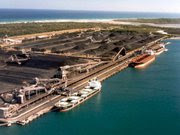
The country last year shipped 62.86 million tons from the terminal, owned by producers including BHP Billiton Ltd. and Xstrata Plc. The terminal handles more than 90 percent of South Africa’s coal exports, while Asia overtook Europe as the country’s main overseas market for the product during the past two years. “The European market is fading but the Asian market is really booming,” McCloskey said. “One in three ships that goes out of Richards Bay now heads for India.” The government should consider appointing a coal “czar” to encourage development of the industry, he said. (source: Bloomberg)
Saturday, January 22, 2011
Australian floods push up coal price
22 January 2011
Angeline Albert SupplyManagement.com
BHP Billiton has reported a 30 per cent drop in coal production between October and December last year due to flooding in Queensland in Australia.In its half-year report, the mining firm said: “Queensland coal production was significantly affected by the persistent rain and flooding that impacted the Bowen Basin in the December 2010 half-year.”
The Bowen Basin in Queensland is the largest coal reserve in Australia and the region accounts for around 56 per cent of the world's exports of coking coal, an essential ingredient in steel manufacturing. The company reported a 24 per cent decline in the production of coking coal in the third quarter, which ended on 31 December.
The report said the heavy rainfall that persisted for much of the late last year “significantly restricted” coal removal. “When combined with disruption to external infrastructure, we expect an ongoing impact on production, sales and unit costs for the remainder of the 2011 financial year.”
But BHP Billiton added its coal sales benefited from a “healthy level of inventory that was held across our supply chain at the commencement of the quarter”.
Spot prices for coking coal having risen above $300 a tonne (£187) this week. Contracts signed before the floods priced the commodity at $225 (£140) a tonne, according to the Sydney Morning Herald.
“As a direct impact of the floods, coal prices have moved rapidly higher, with some estimates indicating that coking coal prices could triple in the short term,” said Australian bank Westpac’s chief economist Bill Evans in a statement.
Wednesday, January 19, 2011
Queensland Cuts Coal Output Forecast 10.5% on Floods
By Ben Sharples - Jan 19, 2011
Queensland cut its annual steelmaking coal output forecast by 10.5 percent and expects resumption of normal mining to take as long three months after record rain in Australia, the biggest exporter of the fuel.
Coking coal output in the 12 months ended June 30 is forecast to be 177.3 million metric tons, down from an initial projection of 198 million tons, Mines and Energy minister Stephen Robertson said in a telephone interview. This compares with 182.1 million in the 12 months ended June 30, 2010.
“Queensland is the world’s largest exporter of seaborne coal, so when our supply chains get interrupted that’s felt by a large part of the world,” Robertson said. “We’ve experienced the largest natural disaster in our history, with flooding that has enveloped almost three-quarters” of the state, he said.
The worst flooding in 50 years may have cost A$2.3 billion ($2.31 billion) in lost coal sales, the Queensland Resources Council estimates, with only 15 percent of the state’s mines operating at full production. It may take between two-to-three months for normal operations to resume, Robertson said.
BHP Billiton Ltd. and Xstrata Plc are among producers who’ve said they may miss deliveries. Force majeure remains in place at four mines operated by Rio Tinto Group, the company said yesterday in its fourth quarter operations report.
Australian hard prime coking coal used by steelmakers sold for $280 a metric ton on average last week, up from $265 the week before, according to IHS McCloskey. Prices may reach $300 a ton this year, McCloskey said Jan. 17. Source : Bloomberg
Saturday, January 15, 2011
Iron ore price negotiations - BHP adopts weekly auction - Report
China Securities Journal, citing a procurement manager at an unidentified steel mill in southern China, reported that mining giant BHP Billiton Ltd has begun auctions for spot iron ore shipments to Chinese steel mills marking the latest shift in its pricing strategy to cash in on rocketing prices.
The report said that BHP has started to auction 170,000 tonne spot iron ore shipment every fortnight to Chinese customers.
If true, it clearly indicates gigantic shift from annul bench mark price to quarterly index based price to monthly finally down to spot, reflecting that at the end of the day market forces prevail.
Iron ore spot market is continuing its upward momentum with approaching spring festival holidays and concerns on supply side. Reports are filtering in for transactions at USD 184 CFR levels on limited high grade parcels from India as well as concerns of a tropical cyclone threatening to interrupt production and shipments in Australia. As the higher grade cargos are very few, talks of up to USD 190 per tonne CFR are starting to be heard.
With the gradual shift form benchmark pricing based long term contracts to spot cargos, it has become more vital for both sellers as well as buyers to precisely monitor the daily movements of iron ore spot prices to keep tab on trends and spot opportunities.
Wednesday, January 12, 2011
BHP Coal Contract Change Spares Consumers Price Surge
BHP Billiton Ltd.’s push to set coal prices quarterly rather than annually may spare steelmakers from a surge in costs after flooding in Australia disrupted mine production in Queensland state.
“The market can respond far quicker than with the 12-month pricing and buyers will be prepared for an increase knowing they can always renegotiate the next contract,” said Gavin Wendt, a senior resource analyst at MineLife Pty in Sydney. “It’s a more fluid market. You probably won’t see the sorts of huge price movements that we saw a couple of years ago.”Steelmakers were hit with a threefold increase in annual contract prices to about $300 a metric ton in 2008 after heavy rains and floods affected mining in Queensland. This year, coal production and deliveries have been disrupted after Australia had its wettest September-to-November spring on record. BHP, the world’s biggest mining company, has urged the industry to move to short-term deals to make prices more responsive to market changes. It agreed with Japan’s JFE Holdings Inc. to the first three-month coking coal contract in March.Coking coal and iron-ore suppliers traditionally held annual talks with steelmakers to fix benchmark contracts for the 12 months from April 1, the start of the Japanese financial year. Quarterly accords mean producers can spread price increases caused by the rain over the course of the year.“Producers are not compelled to push for higher prices now to offset lost production, like they have in recent years, most notably the super-spike of $300 a ton,” UBS AG analysts led-by Sydney-based Tom Price said in an e-mailed note today. “They don’t have to wait another-12-months like they used to.”
Force Majeure
Production has been disrupted at mines operated by Macarthur Coal Ltd., Aquila Resources Ltd., Vale SA and Xstrata Plc. They have all declared force majeure, a legal clause invoked by companies when they can’t meet obligations because of circumstances beyond their control.“We’ve moved now to quarterly pricing, in the old days we had annual pricing,” Keith De Lacy, chairman of Macarthur Coal Ltd., the world’s largest producer of pulverized coal used in steel manufacturing, said on Bloomberg Television on Dec. 8. “The market responds a lot quicker to supply and demand.”BHP agreed with Japanese steelmakers to cut coking-coal prices by 7 percent in the three months ending Dec. 31. Kobe Steel Ltd. will pay $209 a metric ton, from $225 a ton in the quarter from July to September, Hiroyuki Hashimoto, a spokesman for Kobe Steel, said Sept. 1. JFE Holdings’ steel unit reached the same agreement, the company said.
Fiona Martin, spokeswoman for BHP, declined to comment on what percentage of the company’s coal contracts are settled on a quarterly basis. BHP Billiton-Mitsubishi Alliance, known as BMA, is the world’s biggest exporter of coal for steelmaking and operates seven mines in Queensland’s Bowen Basin.
Consumers Concerned “All our readings of the consumer side is that they’re very concerned about making sure that they have enough supply,” Andrew Harrington, an analyst at Patersons Securities Ltd. in Sydney, said Dec. 7. “This year has been unusual because we had a fair amount of rain up in the inland of Queensland in August and September, which is usually the dry period.”Queensland’s coal exports are worth about A$100 ($99 million) a day to the state, Michael Roche, chief executive of the Queensland Resources Council, said Dec. 7. “Some open-cut pits are now looking more like dams than mines,” he said.Australia is the largest producer of coal used in steelmaking, contributing more than 40 percent of the global seaborne trade, Deutsche Bank AG. said Oct. 19. The country is the second-largest exporter after Indonesia of the commodity burned for power.
Sunday, January 9, 2011
BHP, Xstrata, Anglo Coal Operations Hit by South African Rains
By Carli Lourens
Jan. 6 (Bloomberg) -- BHP Billiton Ltd., Xstrata Plc and Anglo American Plc, already facing delays in coal shipments from flooding in Australia, said their South African operations are also being hit by unusually high rainfall.
“Heavy rains over the past few weeks have had an impact on coal production” in South Africa, BHP said in an e-mailed reply to questions today. Preparations before the rainy season have helped to reduce the effect on operations, the company said.
South Africa raised the flood-warning level for its central Orange River area today as water levels in places were expected to reach the highest since 1996. The country’s biggest dam, Gariepdam, is at 113 percent of “full” levels and the second- biggest, Vanderkloof, is 107 percent full, according to figures on the website of the government’s water department.
The national weather service forecast heavy rain, defined as more than 50 millimeters (1.97 inches), in the main coal- producing region of Mpumalanga province in the northeast.
“The recent high level of rain across the country and in particular in the Mpumalanga province have thus far had minimal impact,” Xstrata said in an e-mailed response to queries. “The rains have however had an impact on the poorly maintained roads in the area that could impact some coal logistics.”
Eskom Holdings Ltd., South Africa’s largest electricity supplier, said yesterday that the rains had reduced the amount and quality of coal supplied to four to five of its plants, curbing the company’s ability to generate power. Anglo American, one of Eskom’s largest coal suppliers, said by e-mail its Kriel colliery has been worst affected by the rains.
Opencast Affected
“Opencast mines were affected,” mostly at Kriel, though they are set up to handle heavy downpours, Anglo said.
Eskom Chief Executive Officer Brian Dames told reporters in Johannesburg today that disrupted coal supplies have heightened the risk of power outages in Africa’s biggest economy.
Record rainfall in Australia’s Queensland state has spread flooding over an area the size of France and Germany, disrupting coal mine and rail operations. BHP, Xstrata, Anglo, Rio Tinto Group and Peabody Energy Corp. are among producers to have declared force majeure, a legal measure allowing them to miss contracted shipments due to circumstances beyond their control.
Exxaro Resources Ltd. and Optimum Coal Holdings Ltd. declined to comment on the effect of rains in South Africa.
-Editors: Tony Barrett, Amanda Jordan,
Reporter on this story: Carli Lourens in Johannesburg at clourens@bloomberg.net
Subscribe to:
Posts (Atom)

 Posts